

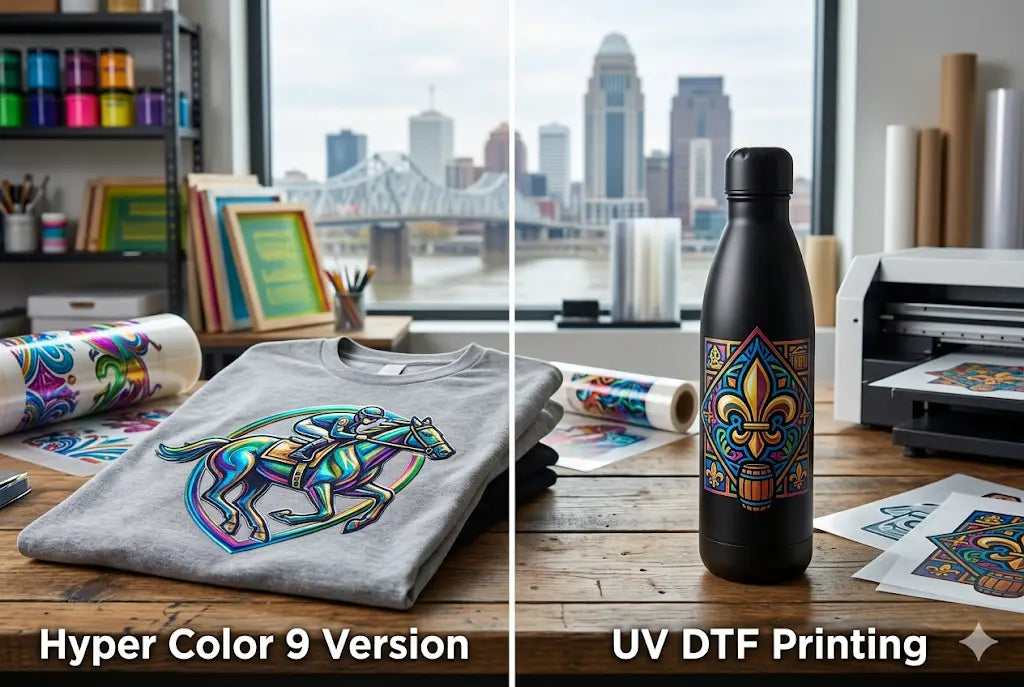
Hyper+ is something a lot of Louisville-area print shops are starting to talk about, especially when comparing it directly with UV DTF printing. At DTF Louisville, we’ve had more shop owners from Louisville, Lexington, Bowling Green, Owensboro, Covington, and Richmond asking the same question: which one actually holds up in day-to-day production?
This isn’t about hype. It’s about what prints clean, sticks right, and doesn’t slow your workflow down. In this breakdown, we’ll walk through how Hyper Color 9 Version performs against UV DTF printing in real shop conditions, including cost, durability, speed, and what customers actually notice when they pick up their order.
You’ll see where each method fits, and more importantly, where it doesn’t.
What Hyper+ Actually Is
Built For Cleaner Transfers, Not Just Print Quality
Hyper Color 9 Version is basically a transfer system built to hold detail better when it hits the final surface. In real shop terms; fewer bad presses, fewer “why is this peeling?” moments. It’s designed to behave more consistently when you’re running batch after batch.
Why Shops In Louisville Are Paying Attention
Most shops around Louisville aren’t looking for fancy tech; they want something that doesn’t slow down production. Hyper Plus fits because it reduces redo work. Once you dial it in, it behaves the same from the first sheet to the last.
What Materials It Actually Works On
We’re seeing solid results on bottles, packaging, acrylic blanks, coated metal, and promo goods. It’s not picky like older systems that only behave on flat surfaces. That matters when you’re doing mixed orders all day.
[Image Alt Text: Hyper+ transfer prints applied to bottles and promo items in production]
Hyper + Vs UV DTF Printing
The Real Difference Isn’t Marketing
UV DTF printing sits on the surface with UV-cured ink. It looks sharp, but it behaves more like a coating. Hyper + actually bonds into the surface differently, which changes how it wears over time.
What You Notice In Day-To-Day Shop Work
UV DTF setups usually mean more machine dependency and more maintenance. Hyper + is more forgiving in smaller shop environments where you don’t have time to babysit equipment all day.
Where Each One Actually Belongs
If you’re doing signage, acrylic display pieces, or rigid branding (UV DTF makes sense If you’re doing everyday branding, merch, stickers, and mixed materials) Hyper+ fits more of the real workload in Louisville shops.
Order UV DTF Transfers and see if they fit your workflow best.
Where Hyper Color 9 Performs Better In Real Shops
Fewer Failed Transfers In Production
This is the part shop owners care about most. Hyper Plus cuts down on reprints. You don’t lose as many sheets when humidity, pressure, or operator differences come into play.
Better Consistency Across Bulk Orders
When you’re running 50, 100, or 500 pieces, consistency matters more than anything. Hyper + holds color and edge detail more evenly across long runs.
Works Better In Mixed-Order Days
Most Louisville shops aren’t running one product type all day. You’ve got stickers, bottles, labels, and merch mixed together. This system handles that switching without constant recalibration.
Raised Effect And Durability In Daily Use
The Raised Effect Customers Actually Notice
Hyper + gives a slight raised feel that clients often describe as “premium” without you having to explain it. It’s subtle, but it changes perception when someone touches the product.
Holds Up In Real-World Handling
We’re talking backpacks, drinkware, outdoor promo items — stuff that gets tossed around. It holds up well under normal wear, especially compared to flatter sticker-style systems.
Waterproof Sticker-Style Applications
A lot of Louisville shops are using it for waterproof branding labels now. It handles moisture and handling better than standard vinyl in most everyday conditions.
Best Local Use Cases In Kentucky Print Shops
Small Businesses Ordering In Short Runs
Around Louisville and nearby cities, most small businesses don’t want 1,000-piece orders. Hyper + fits because it works well in low to mid batch production without killing margins.
Event And Seasonal Merch
Local events, pop-ups, and seasonal campaigns are big in this region. This system works well when you need fast turnaround without setting up full production cycles.
Retail Branding And Packaging
We’re seeing more retail shops using it for packaging labels and in-store branding pieces. It keeps things consistent without needing industrial-level setups.
When UV DTF Makes More Sense
When The Job Is Strictly Display Work
If the end product is going on a shelf or wall and not being handled much, UV DTF works fine. It gives a clean, glossy finish that looks sharp under lighting.
When You’re Doing Rigid Materials Only
Acrylic signage and hard surface branding is where UV DTF stays strong. It’s not trying to compete with flexible transfer systems in that space.
When Visual Gloss Matters More Than Flexibility
Some clients want that high-gloss, almost sticker-coated look. UV DTF delivers that better than transfer-based systems.
What Most Louisville Shops Get Wrong When Choosing
Picking Based On Price Alone
Most shops start by comparing cost per sheet. That’s not the real number that matters. Waste, reprints, and downtime usually cost more than material price.
Not Thinking About Order Mix
If your shop only does one type of product, UV DTF might make sense. But most Louisville shops don’t work that way anymore — it’s mixed daily production.
Ignoring Operator Learning Curve
Some systems look good on paper but slow your team down in practice. Hyper + tends to be easier to keep consistent across different operators.
Hyper Color 9 Printing At DTF Louisville
What We Actually Handle Day-To-Day
At DTF Louisville, we run Hyper + jobs for local shops across Louisville, Lexington, Bowling Green, Owensboro, Covington, and Richmond. Most of it is repeat work — branding, merch, and labels that need to stay consistent.
Support For Shop Owners, Not Just Orders
We’re not just pushing prints out. We help shops figure out what actually fits their workflow so they’re not stuck with equipment or systems they don’t need.
Local Turnaround Matters Here
Being local to Kentucky means fewer delays and faster fixes when something needs adjusting mid-run. That’s something out-of-state suppliers don’t handle well.
Conclusion
If you strip all the marketing talk away, Hyper + vs UV DTF printing comes down to how your shop actually runs day to day. In Louisville and surrounding Kentucky cities, most print shops are dealing with mixed orders, tight deadlines, and customers who expect consistency every time.
Hyper + fits that kind of work better for most general production environments. UV DTF still has its place for rigid display-style work, but it’s not built for everything.
At DTF Louisville, we help shops across Louisville, Lexington, Bowling Green, Owensboro, Covington, and Richmond choose what actually makes sense for their workflow; not just what looks good on paper. If you want to compare samples or run a test batch, reach out and we’ll set it up with your real production needs in mind.
FAQ
Is Hyper + better than UV DTF printing for Louisville shops?
It depends on what you’re producing. Most Louisville print shops using mixed materials find Hyper+ more practical because it handles flexibility and bulk runs better. UV DTF is still useful for rigid display items, but it’s not as versatile for daily shop production work.
What makes Hyper+ different in real production?
The biggest difference is consistency. It reduces failed transfers and keeps output more stable across long runs. In a busy shop, that means less wasted material and fewer reprints, which matters more than specs on paper.
Can Hyper Plus handle waterproof stickers?
Yes, it performs well for waterproof sticker-style applications. It holds up against moisture and regular handling. It’s commonly used in Louisville for drinkware, packaging labels, and outdoor promo items where durability is important.
Is UV DTF printing still worth it for print shops?
Yes, but in a narrower role. UV DTF works best for rigid materials like acrylic signage and display pieces. If your shop focuses on that type of work, it still makes sense. For general merchandise, it’s less flexible than Hyper+.
What kind of products work best with Hyper Color 9 transfers?
Bottles, packaging, promotional items, retail merch, and mixed-material branding jobs. It’s used heavily in small business branding across Kentucky because it adapts well to different surfaces without needing separate production setups.
Does Hyper + help reduce production cost?
Indirectly, yes. The savings come from fewer failed prints and less wasted material. Shops in Louisville typically see better efficiency over time because they spend less time correcting errors or re-running batches.
Why are Louisville print shops switching to Hyper Plus?
Most are switching because they want fewer production issues and more predictable output. It fits better into real-world shop workflows where orders change daily and speed matters as much as print quality.
Is Hyper+ good for small businesses?
Yes. It works well for small businesses that don’t want large minimum orders. It supports short runs and repeat branding jobs without requiring big production commitments.
How does DTF Louisville support Hyper+ printing?
DTF Louisville handles production for shops across Kentucky, helping with consistent output, sample testing, and bulk orders. The goal is to match the printing method to the actual workload instead of forcing one system for everything.
What’s the biggest mistake shops make choosing between these systems?
Choosing based only on upfront cost. The real difference shows up in waste, reprints, and workflow speed. Shops that ignore production flow usually end up switching systems later after losing time and material.
Share:
The Best Heat Press Settings for DTF Transfers on Sports Apparel
Hyper+ for branding in Louisville (Features + Benefits)