


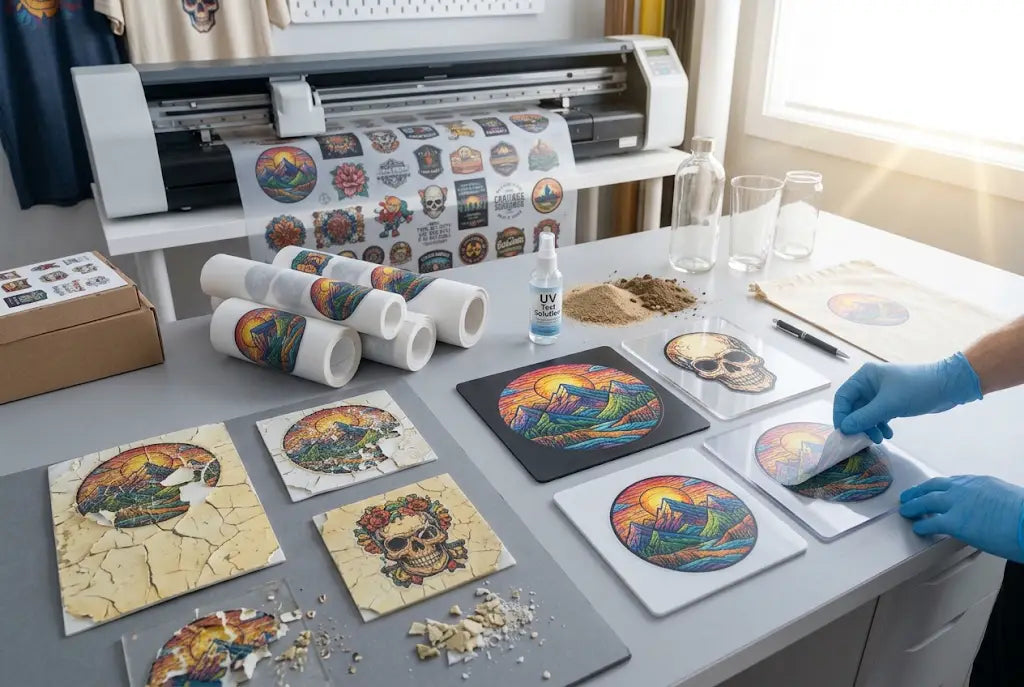
If you're putting UV DTF transfers on plastic signs that will live outside, the plastic you choose matters more than the transfer itself. Some plastics hold color and adhesive for 2 plus years in sun and rain. Others crack, yellow, or let the decal lift in 90 days.
In this post you'll learn what UV DTF transfers on plastic actually are, why outdoor exposure kills certain plastics, which hard plastics survive and which fail fast, how to test a blank in 10 seconds before you buy 200 of them, and how to prep and apply for long-term outdoor durability. Real numbers included.
UV DTF Transfers on Plastic: Which Hard Plastics Survive Outdoors for 2 Plus Years
Not all hard plastics are equal. Surface energy and UV stability decide who survives. Surface energy is measured in dynes. Higher dyne means better adhesion.
Polycarbonate is the king for outdoor. It has 46 dyne, high impact strength, and built-in UV resistance if you buy a UV-stabilized sheet. It holds UV DTF transfer plastic adhesion at 6 to 7 pounds per inch and doesn't crack in sun. Cost is $2.20 to $3.50 per square foot for 3mm UV-stabilized, but it lasts 3 to 5 years outside.
Acrylic, specifically cast acrylic, is second best. Cast acrylic is 38 to 41 dyne, holds color well, and resists yellowing. Extruded acrylic is cheaper but cracks faster in the cold. For outdoor signs, use 3mm to 6mm cast acrylic. It holds 18 to 30 months outdoors with proper prep.
ABS is surprisingly good. ABS is 42 dyne, cheap at $1.10 to $1.80 per square foot, and bonds well. It yellows slightly after 18 months in full sun unless painted, but it doesn't crack. Great for parking signs and utility signs where color shift is less critical.
PET and PETG sit in the middle. PET is 44 dyne and holds adhesion well for 12 to 18 months, but thin PETG warps in heat above 120°F. Use 3mm or thicker for outdoor use.
Which Plastics Crack, Yellow, or Peel in 3 Months
Here's where shops lose money. They buy cheap blanks and blame the transfer.
Polypropylene is the worst for UV DTF on polypropylene outdoors. PP is 29 to 31 dyne, very low surface energy, and has wax in the plastic that repels adhesive. Even with adhesion promoters, success rate is 55% to 75% indoors and drops to 30% outdoors after heat cycling. It also chalks in the sun in 90 days.
Polyethylene, both HDPE and LDPE, is just as bad. PE is 31 dyne, soft, and expands a lot with heat. Your UV DTF stickers for plastic will look fine on day one and lift at edges after two hot days. Avoid any outdoor signs.
Styrene and expanded PVC foam boards look tempting because they're cheap at $0.60 to $0.90 per square foot. Styrene cracks in cold below 40°F and yellows in 3 to 4 months of sun. Foam PVC absorbs water at cut edges and swells, pushing the decal off.
Soft PVC and vinyl banners are not for UV DTF. Plasticizer migrates out of soft vinyl and breaks down adhesive in 60 to 90 days.
How to Test Any Plastic Blank in 10 Seconds Before You Buy 200
You don't need a lab meter. Use the water drop test.
Clean a small corner with 90% isopropyl alcohol. Put one drop of water on it. If water beads up tight like on a waxed car, dyne is low, around 30 to 32, and UV DTF will struggle. That's polypropylene and polyethylene. If water spreads out slightly but still beads, dyne is medium, 38 to 42, workable with good prep. That's acrylic and ABS. If water sheets out flat, dyne is high, 44 to 46, and adhesion will be strong. That's polycarbonate and PET.
For outdoor signs, only buy blanks that sheet water or spread. If it beads tight, walk away even if price is half. We have seen distributors lose $1,200 on a 200-sign order because they saved $0.40 per blank on PP.
Why Do UV DTF Transfers Work on Plastic Some Times and Fail Others
Do UV DTF transfers work on plastic? Yes, on high dyne hard plastics. They fail on low dyne soft plastics.
The confusion comes from sellers calling everything plastic. A hard ABS plastic sign and a soft polypropylene cutting board are both called plastic but have 11 points dyne difference. That difference is the difference between 2-year hold and 2-week peel.
Thickness matters too. Thin plastic under 2mm moves more with temperature. A 1.5mm styrene sign will bow 0.25 inches in sun at 100°F. That movement shears the adhesive edge. Use 3mm minimum for outdoor. For large 24x36 inch signs, use 6mm to prevent wind flex cracking.
How to Prep Outdoor Plastic So UV DTF Actually Holds for Years
Outdoor prep is different from indoor keychain prep. You have to remove mold release and UV coating dust.
First, peel any masking and wipe with 90% IPA twice with lint-free cloth. Most plastic sheets have silicone mold release you can't see. Second, scuff lightly with a gray Scotch-Brite pad on the print area only, then wipe again with IPA. This micro texture raises surface area by 20% and improves UV DTF transfer plastic adhesion from 3 pounds to 6 pounds per inch on ABS and polycarbonate.
Don't use an adhesion promoter on polycarbonate unless it's polypropylene. The promoter can cloud clear polycarbonate and doesn't add much on high dyne plastics. For UV DTF on polypropylene, you must use a polypropylene-specific promoter. The regular promoter does nothing on PP. Even then, expect 75% success, not 100%.
Apply at 70 to 75°F. Cold plastic below 60°F makes adhesive stiff and reduces flow into micro texture.
How to Apply UV DTF on Hard Plastic Signs Without Trapping Air
Hard plastic signs are flat, so you can use more pressure than on curved tumblers.
Lay the sign flat on a firm table, not carpet. Position UV DTF stickers for plastic and tack one edge with 1 inch hinge. Squeegee from center out with felt squeegee using firm overlapping strokes. You should hear a slight scratch. Do three full passes. Corners need extra 10-second press.
Peel carrier at low 180-degree angle, flat to surface, slow at 2 inches per second. If a small letter lifts, lay back down and squeegee again. Don't stretch film. UV DTF film has zero stretch memory and will pull back outdoors with heat.
For large signs over 18 inches, have a second person hold the opposite end of the carrier so it doesn't drag dust onto adhesive as you peel. Dust under large decals shows as silver fish-eyes in the sun.
The Edge Seal Trick That Doubles Outdoor Life at DTF Louisville
Edge lift is how outdoor signs fail. Water gets under edge, freezes, and pops decal.
After application and 24-hour dwell, run a thin line of clear UV-resistant edge sealer or clear acrylic pen around the entire perimeter. Cost is $0.04 to $0.08 per linear foot and adds 5 minutes per sign. It seals the edge from water intrusion and raises outdoor life from 12 months to 24 plus months on polycarbonate and acrylic. For signs that will be pressure washed, this step is not optional.
Let dwell 24 to 36 hours before sealing and before taking outside. Adhesion reaches 60% immediately but needs 24 hours to reach full 100%. Shops that pack the same day and ship to customers who install the next day see 12% return rate versus under 2% with dwell.
Cost and Lifespan Comparison That Helps You Quote
Real numbers for quoting outdoor signs.
3mm UV-stabilized polycarbonate 12x18 inch blank: $5.80 to $7.50. UV DTF full face transfer gang printed: $2.20 to $3.40. Labor prep and apply: $1.20. Total $9.20 to $12.10. Sells at $45 to $75 as custom outdoor sign. Lifespan 36 to 60 months.
3mm cast acrylic 12x18: $4.50 to $6.00 blank, same transfer cost, total $7.90 to $10.60, lifespan 18 to 30 months, sells $40 to $65.
Polypropylene same size: $2.80 blank, transfer $2.20, labor $1.20 plus promoter $0.30, total $6.50 but lifespan 2 to 4 months and remake rate 35%. It looks cheaper until you replace it twice.
For outdoor, quote polycarbonate first. It's 30% more upfront but half the cost over 2 years.
Common Misconceptions That Cost You Money
Misconception one: All hard plastic holds the same. No. PP is hard but fails. ABS is hard and holds.
Misconception two: Thicker adhesive fixes low dyne plastic. No. Adhesive can't overcome 29 dyne. You need different plastic.
Misconception three: UV DTF is waterproof so any plastic works outside. Ink is waterproof. Plastic moves, yellows, and cracks. Plastic failure looks like transfer failure but it's substrate failure.
Misconception four: You can use a heat gun to help adhesion on plastic. Don't. Heat warps thin plastic and creates bubbles that appear a week later.
Conclusion
Choosing plastic for outdoor signs is about dyne level and UV stability, not just price. If you remember one thing, remember this. High dyne plastics like polycarbonate at 46 dyne and cast acrylic at 40 dyne hold UV DTF transfers on plastic for years. Low dyne plastics like polypropylene at 30 dyne and polyethylene at 31 dyne will peel even with promoters, especially when sun and rain cycle daily.
Test every new blank with a water drop. If it beads tight, don't buy it outdoors. Prep with double IPA wipe, light scuff, and firm center-out squeegee, then let dwell 24 hours and seal edges if the sign will be washed or face rain. Do that and your outdoor signs from DTF Louisville will survive seasons, not months, and your customers won't call you in spring to say their sign cracked.
Frequently Asked Questions
Do UV DTF Transfers Work on Plastic for Outdoor Signs?
Yes, but only on high surface energy hard plastics like polycarbonate, cast acrylic, ABS, and PET. These have 38 to 46 dyne and hold adhesive 18 to 60 months outdoors. Low energy plastics like polypropylene and polyethylene have 29 to 31 dyne and peel in 2 to 4 months outdoors even with adhesion promoters.
Which Plastics Are Best for UV DTF Transfers on Plastic Outdoors?
Polycarbonate UV-stabilized is best for 3 to 5 years outdoors, followed by cast acrylic for 18 to 30 months and ABS for 18 to 24 months with slight yellowing. All have 38 to 46 dyne. Avoid polypropylene, polyethylene, styrene, and foam PVC for outdoor use because they crack, yellow, or peel in 90 days.
How Do You Test If UV DTF Stickers for Plastic Will Stick?
Clean with 90% IPA and place a water drop. If water sheets are flat, the dyne is high at 44 to 46 and adhesion will be strong. If it spreads slightly, dyne is medium at 38 to 42 and workable. If it beads tight like wax, dyne is low at 29 to 31 and UV DTF stickers for plastic will likely fail.
Can You Use UV DTF on Polypropylene Outdoors?
You can, but you shouldn't for outdoor signs. UV DTF on polypropylene has 29 to 31 dyne and even with PP-specific promoters only reaches 55% to 75% success indoors. Outdoors, heat cycling and UV chalking drop success to 30% and cause edge lift in 60 to 90 days. Use polycarbonate instead for outdoor use.
What Is the Best Way to Prep UV DTF Transfer Plastic Adhesion for Outdoors?
Wipe twice with 90% IPA, lightly scuff print area with gray Scotch-Brite to raise surface area 20%, wipe again with IPA, apply at 70 to 75°F, squeegee three times center out, dwell 24 to 36 hours, then seal edges with clear UV sealer. This raises UV DTF transfer plastic adhesion from 3 to 6 plus pounds per inch.
Do You Need an Adhesion Promoter for UV DTF on Hard Plastic?
For hard high dyne plastics like polycarbonate, acrylic, and ABS, no, IPA prep is enough. For low dyne plastics like polypropylene and polyethylene, you need PP-specific promoters and even then success is limited. Promoters can cloud clear plastics if over applied, so test on scrap first before full run.
How Long Do UV DTF Transfers on Hard Plastic Last Outside?
On UV-stabilized polycarbonate, UV DTF transfers on hard plastic last 36 to 60 months. On cast acrylic, 18 to 30 months. On ABS, 18 to 24 months with slight yellowing. On PET, 12 to 18 months. These numbers assume proper prep, 3mm plus thickness, and 24 hour dwell before exposure.
Why Does My Outdoor Plastic Sign Crack After 3 Months?
Cracking in 3 months is substrate failure, not transfer failure. Styrene cracks below 40°F, thin PETG warps above 120°F, and non-UV stabilized acrylic yellows and becomes brittle. Use UV-stabilized polycarbonate or cast acrylic at 3mm minimum for outdoor use. At 6mm for signs over 24 inches to prevent wind flex cracking.
What Thickness Plastic Works Best for UV DTF Transfers on Plastic Signs?
Use 3mm minimum for signs up to 18x24 inches and 6mm for larger signs. Thin plastic under 2mm bows 0.25 inches in 100°F sun and shears adhesive edge. Thicker plastic resists heat movement and wind flex. Cost difference is $1.20 per square foot but cuts remake rate from 15% to under 2%.
Does DTF Louisville Offer UV DTF Transfers for Outdoor Plastic Signs?
Yes, DTF Louisville offers gang sheets and single wraps optimized for outdoor hard plastics with high-tack adhesive for polycarbonate and acrylic. We include a free prep guide and size your art for 3mm and 6mm blanks. Upload your artwork and note outdoor use and we will recommend the best plastic and finish.
Share:
How to Prep Glass for UV DTF: Alcohol vs Soap vs Primer for Long-Lasting Adhesion
UV DTF Tumbler Size Guide: How to Measure and Gang Print Wraps That Fit Perfectly