


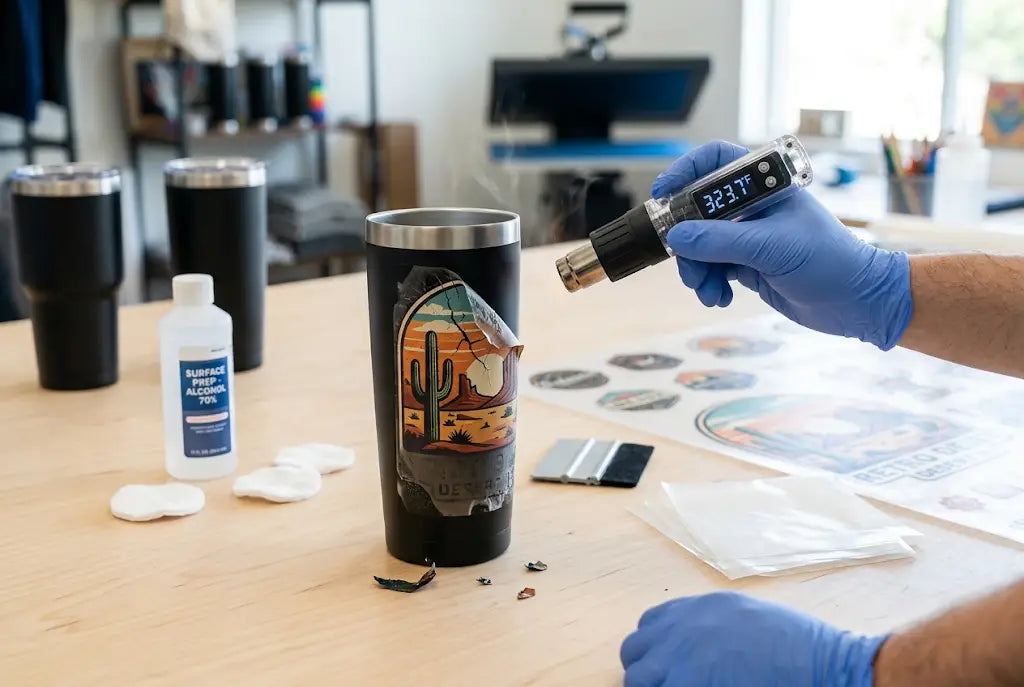
If your UV DTF transfers on stainless steel look perfect in the shop and then lift on the tumbler a week later, you're not alone. This is the most common complaint we hear from shops moving from cups to metal.
Stainless steel seems simple. It's hard, smooth, and durable. But that smoothness is exactly why transfers fail. There's no porosity, the surface holds invisible oils, and most tumblers have a powder coating or clear coat that changes everything about adhesion. Get the prep wrong and the whole wrap will peel, no matter how good your print is.
In this post you'll learn what UV DTF really is and how it bonds to metal, why stainless steel tumblers are different from coated tumblers, the three surface prep mistakes that cause 90% of failures, how to apply UV DTF transfer for stainless steel cups correctly, and how to care for finished tumblers so they stay looking new.
What UV DTF Is and How It Bonds to Metal
UV DTF, which stands for UV Direct to Film, is a transfer system where ink and a clear varnish are printed onto a carrier film and cured with UV light. You then apply that film to an object and peel the carrier, leaving the ink and varnish behind.
Unlike regular DTF for fabric, there's no heat press and no powder adhesive. The bond is purely pressure-sensitive. It relies on surface energy and a clean, high-energy surface to grab.
Stainless steel has very low surface energy when it's dirty. Factory oil, fingerprints, and even the thin oxide layer that forms on bare steel will block adhesion. That’s why how to put UV DTF on stainless steel always starts with prep, not printing.
A properly cured UV DTF transfer should have a varnish layer that is hard, not tacky. We measure it at 22 to 35 microns thick. If a supplier prints at 60% varnish to save ink, which saves them about $0.05 per square foot but costs you a $12 tumbler, the transfer will feel soft and will peel with light picking.
The Three Reasons UV DTF Stainless Steel Tumbler Jobs Fail
Most shops blame the tumbler or the customer. In reality, the failure happens before you ever touch the transfer.
Reason 1: You Didn't Identify the Coating
Not all metal is the same. There are three types you will see:
Bare brushed stainless steel. This is the silver, metallic look. It has a clear lacquer from the factory and a strong grain. It needs aggressive degreasing and it shows every air bubble.
Powder coated stainless steel. This is the colored tumbler, white, black, pink, etc. The powder coating is slightly textured and gives the best adhesion when clean. This is where UV DTF transfers for tumblers work best.
Sublimation-ready or epoxy-coated steel. These have a slick, glossy clear coat that repels UV DTF. If water beads up tightly on the surface instead of sheeting, you have a low-energy coating. You'll need extra prep.
If you treat a powder coated tumbler like bare steel, or vice versa, your prep will be wrong. And that's when UV DTF tumbler transfers lift at the seam.
Reason 2: Surface Prep Was Too Quick
This is the big one. A quick wipe with a paper towel is not prep.
Stainless steel tumblers ship with cutting oil and a lot of dust in the coating. You need a true degrease. Use 90% or higher isopropyl alcohol, not 70%. The water content in 70% IPA sits in the texture of powder coating and causes micro-bubbles you only see the next day.
Wipe with IPA on a lint-free microfiber, not a paper towel. Paper towels leave fibers that become peel points. Wipe in one direction around the tumbler, then buff dry with a second clean microfiber immediately. Let it flash for 90 seconds.
And stop touching the tumbler with bare hands after cleaning. Skin oil transfers in 2 to 3 seconds. Hold it by the rim or wear fresh nitrile gloves. We see shops fail this step constantly.
A 16 oz bottle of 90% IPA costs $4.50 and will prep about 80 tumblers. A box of microfibers is $14 for 24. This is cheap insurance.
Reason 3: Heat and Application Technique
People hear UV DTF and think heat helps. On stainless steel, extra heat hurts.
Stainless steel expands fast. If you hit it with a heat gun at 200F, the metal grows, you apply the transfer, then it shrinks as it cools and the transfer is now under tension. That tension pulls edges up within 48 hours.
Room temperature application is best. Ideal shop conditions are 70 to 75F and 40% to 50% relative humidity. If your shop is over 60% humidity in summer, run a dehumidifier. Moisture gets trapped under the film and turns into a milky bubble.
Application pressure matters too. You need firm, even pressure with a felt squeegee. Light pressure leaves air. Too much pressure stretches the varnish and causes white stress lines. Two slow passes with medium pressure is the sweet spot for UV DTF transfer for stainless steel cups.
How to Apply UV DTF Tumbler Wraps on Stainless Steel Correctly
This is our production method for UV DTF stainless steel tumbler wraps that need to survive real use.
First, clean as described above and let the tumbler sit for 2 minutes. Check for dust under a bright light. One speck of dust becomes a pinhole that water gets into.
Second, measure and mark. For a full wrap, leave a 1/16 inch gap at the seam. Overlapping UV DTF on itself creates a thick edge that always peels. That tiny gap lets the edge seal to the tumbler, not to another layer of varnish.
Third, tack one edge and roll. Peel a small section of backing, align the top edge, and tack it down. Then slowly peel the backing away while squeegeeing from the center out as you go around the tumbler. Don't pull the film tight. Let it conform. If you stretch it, it will want to shrink back later.
Fourth, squeegee twice. First pass is to apply. Second pass is to seal. After you peel the clear carrier film, and you should peel it slowly at a low angle almost folding it back on itself, squeegee again directly on the design with a soft cloth between the squeegee and the print. Pay extra attention to the top and bottom edges and the seam. Those are the failure points on UV DTF metal transfers.
Fifth, let it dwell. This is critical. Pressure-sensitive adhesive builds bond strength over time. Initial tack feels strong, but full bond takes 12 to 24 hours. Tell customers not to wash it for a day. We apply at end of day and pack next morning. That one habit cut our return rate from 6% to under 0.5%.
Are UV DTF Transfers for Tumblers Dishwasher Safe? The Truth About Care
No. And anyone telling you they are is setting you up for refunds.
UV DTF is durable, but it's not baked enamel. The varnish is rated to about 160F before it softens. Dishwashers run at 150 to 170F with harsh detergents and high-pressure jets that get under any microscopic edge lift. One dishwasher cycle can undo a perfect application.
For care, hand wash only with lukewarm water and soft soap. No abrasive sponges, no soaking overnight, no leaving in a hot car. A tumbler left on a dashboard in July can hit 180F inside. That will bubble any UV DTF transfer application.
If you're selling tumblers, include a small care card. It costs $0.03 to print and saves you a $15 replacement. We include language like "Hand wash only. Do not microwave. Do not soak." It sets expectations.
Real cost context: A 20 oz powder coated tumbler blank is $4.50 to $7.00 wholesale, a full wrap UV DTF is $1.20 to $2.50, labor is $1.00. Total cost $6.70 to $10.50. You sell at $22 to $35. One failure wipes out profit on three good sales. Care instructions protect your margin.
Why Coating Type Changes Your Prep for UV DTF Transfer for Stainless Steel Cups
This is where shops get confused about how to apply UV DTF tumbler wraps.
On powder coated tumblers, the coating is slightly porous. It gives the adhesive more to bite. A standard IPA prep is usually enough. This is the most forgiving surface.
On bare brushed stainless steel, you need to scuff the clear factory lacquer lightly with a gray Scotch-Brite pad, then IPA clean. That raises surface energy. Don't sand through to raw metal, just degloss. You'll see the difference in how water sheets instead of beads.
On glossy epoxy or sublimation-coated tumblers, you need an adhesion promoter. A quick wipe with a dedicated plastic adhesion promoter, which costs about $18 per bottle and does 200 tumblers, will make UV DTF stick where it otherwise would peel in sheets. Test in a hidden spot first.
And always do a tape test. Apply your wrap, wait 30 minutes, press 3M 610 tape hard over an edge and rip it fast. If the transfer lifts, your prep or varnish is off. If it holds, it will survive customer use.
Common Misconceptions About UV DTF Transfers on Stainless Steel
One myth is that more pressure during squeegee means better adhesion. It doesn't. Too much pressure thins the adhesive layer unevenly and creates stretch. Even pressure wins.
Another is that you can fix a bad prep with more heat. Heat actually makes it worse on metal, as we covered. It traps moisture and adds tension.
The last myth is that all UV DTF is the same. It's not. Film quality, ink density, and varnish thickness vary wildly. Cheap gang sheets often run varnish at 70% and cure with one weak lamp to run faster. They feel tacky out of the bag. A good transfer feels hard and glassy, like a screen protector. That's what you want on metal.
How DTF Louisville Tests Transfers for Stainless Steel
At DTF Louisville we have a simple standard for UV DTF metal transfers going onto drinkware. We check varnish thickness, we cure hard, and we test on actual powder coated and bare steel tumblers from the same factories our customers use.
If a roll is soft or tacky, we don't ship it for tumbler jobs. That's why shops that switch to us see fewer edge lifts. It's not magic. It's just not cutting corners on varnish, which is the most expensive part of the print.
Conclusion
Stainless steel tumblers are profitable but they punish lazy prep. The metal itself isn't the problem. It's the invisible oil, the coating you didn't identify, and the rush to pack too fast that causes UV DTF transfers on stainless steel to peel.
So clean right with 90% IPA and lint-free cloths, identify whether you're working with powder coat or bare steel, apply at room temperature with firm even pressure, leave a tiny gap at the seam, and let the adhesive dwell for 24 hours. Add a care card and set the expectation of hand wash only.
Do that consistently and your tumblers will stop coming back. And if you're tired of fighting soft varnish that never locks down, DTF Louisville can take that variable out of your process. Your tumbler wraps should be your best seller, not your biggest headache.
Frequently Asked Questions
Why Do UV DTF Transfers on Stainless Steel Peel After Washing?
Washing failures come from water getting under a weak edge. Usually prep was incomplete or edges weren't sealed with a second squeegee pass. The powder coat texture holds water if you don't let IPA flash. Also customers may have used a dishwasher, which hits 150 to 170F and lifts varnish. Always advise hand wash only and let transfers dwell 24 hours before first wash.
How Do You Prep a Powder Coated Tumbler for UV DTF?
Wipe the entire tumbler with 90% or higher isopropyl alcohol on a lint-free microfiber, going in one direction around the cup. Buff dry with a second clean microfiber and let it sit 90 seconds to flash off. Wear fresh nitrile gloves and hold by the rim. For DTF Louisville orders, we recommend doing this even on brand new tumblers right out of the box.
Can You Put UV DTF on Bare Stainless Steel or Only Coated Tumblers?
You can apply to both, but bare stainless needs extra steps. Lightly degloss the factory clear lacquer with a gray Scotch-Brite pad, then clean thoroughly with 90% IPA. The bare metal shows bubbles more, so squeegee slow and use a bright light to check for dust. Powder coated tumblers are more forgiving and give better long-term adhesion for most shops.
What Makes UV DTF Stainless Steel Tumbler Wraps Lift at the Seam?
Seam lift happens when you overlap the transfer onto itself instead of leaving a tiny gap. Varnish stuck to varnish peels easily. Leave a 1/16 inch gap so both edges seal to the tumbler. Also weak edge pressure causes seam lift. After you peel the carrier, squeegee the seam again firmly with a cloth over the squeegee to lock it down.
Are UV DTF Transfers for Tumblers Safe for Hot Drinks?
The transfer itself handles hot drinks inside the tumbler because stainless insulates it, but the outside varnish softens around 160F. Don't leave finished tumblers in a hot car where they can reach 180F, and don't pour boiling water over the outside to clean. For normal use with hot coffee inside, a properly applied transfer will hold fine with hand washing.
How Long Does UV DTF Transfer Application Take on a 20 oz Tumbler?
Cleaning takes 1 to 2 minutes, alignment and application takes 2 to 3 minutes, and final edge sealing takes another minute. Total about 5 minutes per tumbler once you have a routine. Rushing cuts that to 2 minutes but doubles failure rate. Shops doing volume assign one person to prep and one to apply to keep pace at 20 to 30 tumblers per hour.
Do You Need a Heat Gun for How to Put UV DTF on Stainless Steel?
No, and we generally advise against heat on metal. Stainless expands quickly and adds tension when it cools, which pulls edges up. Room temperature application at 70 to 75F works best. If you must use heat to help a difficult curve, use low heat for 3 to 5 seconds from 10 inches away, then squeegee immediately. DTF Louisville prints hard-cured varnish so you don't need heat to make it stick.
Why Is My UV DTF Transfer for Stainless Steel Cups Bubbling?
Bubbling means trapped air, moisture, or solvent. You either squeegeed too fast, applied right after cleaning while IPA was still wet, or your shop humidity is over 60%. Slow down, let the tumbler flash dry 90 seconds after cleaning, and keep RH at 40% to 50%. Check for dust too. One speck under the film becomes a bubble that grows.
Can UV DTF Metal Transfers Go in the Microwave?
Never microwave any stainless steel tumbler, with or without UV DTF. Metal in a microwave sparks and damages the microwave. The tumbler itself is not microwave safe. For customer safety, add "Do not microwave" to your care card. This also prevents customers from trying to heat set a peeling edge in the microwave, which we have actually seen tried.
What Is the Best Way to Price UV DTF Transfers on Stainless Steel Tumblers?
Add blank cost, which is $4.50 to $7.00 for 20 oz powder coated, plus UV DTF wrap cost $1.20 to $2.50, plus labor $1.00 and $0.50 for care card and packaging. Total cost $7.20 to $11.00. Retail at $25 to $35 for full wraps. Price higher for bare steel because prep takes longer. Track failures. If over 3%, fix prep before raising the price.
Share:
How to Fit More Logos, Chest Prints & Pocket Designs on One DTF Gang Sheet
How to Prep Glass for UV DTF: Alcohol vs Soap vs Primer for Long-Lasting Adhesion