


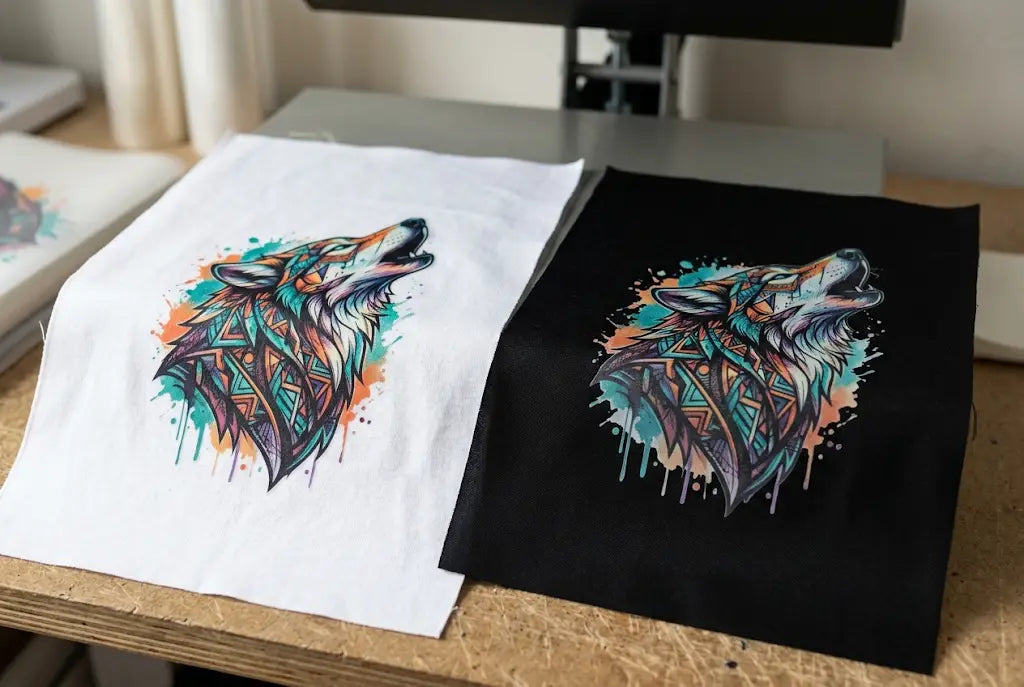
If you've ever pressed the exact same DTF transfer on a white cotton tee and a black polyester shirt, you know they're not even close to the same result. On white cotton, DTF is effortless: colors look vibrant, whites stay white, and the print feels locked in. On black polyester, things change a bit. You have to fight dye-migration, dull colors, and that cheap, plasticky look if your temp is even a little off. One shirt gets you a 5-star review, the other gets you a return. That's why understanding your blank is just as important as your transfer.
In this post, you'll learn what a DTF transfer actually is, how white ink and powder work, why white cotton and black polyester need completely different settings, what dye migration is and when you need a blocker, and how to choose the right transfer so you don't waste shirts, time, and money.
What a DTF Transfer Actually Is and How It Works
A DTF transfer, which stands for Direct-to-Film transfer, is an image printed onto a special PET film using CMYK inks plus white ink, then coated with a hot-melt adhesive powder and cured with heat. The print is created in reverse, white last, so that when you press it onto fabric the white layer sits between the color and the shirt. That white layer is what makes DTF work on both light and dark garments.
The process is straightforward but precise. The printer lays down color at 720 to 1440 DPI, then prints a white underbase at 60 to 100% density. The film passes through powder that sticks only to wet ink, then through a curing oven at 220 to 250F for 90 to 120 seconds. The powder melts and creates the glue that bonds to fabric. When you press it at 300 to 320F for 12 to 15 seconds at 8 to 10 PSI, the adhesive bonds and you peel the film away. The transfer itself is the same, but how much white you print and what powder you use changes everything for white cotton versus black polyester.
Explore custom DTF transfers to start trying them on blank apparel. Or create simply a custom t-shirt if you don’t want to build a hassle-free merch.
DTF Transfers for Light Shirts vs DTF Transfers for Dark Garments: Why the White Ink Layer Changes Everything
Here's the core technical difference. DTF transfers for light shirts need less white ink because the shirt itself is already bright. DTF transfers for dark garments need a solid white block, or your colors will look muted.
On a white cotton shirt, the fabric reflects light back through the ink. You can print white at 40 to 60% and still get vibrant color. That saves 20 to 35% white ink, which is the most expensive ink at $85 to $120 per liter. It also makes the hand feel softer, about 15 to 20% thinner than a full white block.
On a black cotton shirt or black polyester, you need 80 to 100% white density. Black absorbs light, so without that opaque white, your reds turn brown, your yellows turn mustard. We measure opacity with a densitometer, and for true black coverage you need a white density reading of 1.40 or higher. Anything below 1.10 will look greyish on black. This works well because white ink is formulated with titanium dioxide, which is highly opaque and also acts as a light reflector.
So no, they're not the same. Same film, different white layer. And that difference is the difference between a $24.99 shirt that sells and one you have to discount.
How to Use DTF Transfers on Light Shirts Without Wasting Ink and Hand Feel
How to use DTF transfers on light shirts is where a lot of small shops overspend. You don't need maximum white on white or ash or natural shirts.
For DTF transfers for light garments like white, off-white, light grey, and pastels, set your white underbase to 50 to 65% and use a choke of 2 to 3 pixels. A choke shrinks the white layer slightly inside the color edge so you don't see a white outline. This keeps the print thin and breathable. Press at 300F for 12 seconds with medium pressure. You don't need heavy pressure on light cotton because there's no dye to fight.
The cost difference is real. A standard 10x10 inch transfer with 100% white uses about 1.2 to 1.4 ml of white ink. The same transfer at 50% white uses 0.6 to 0.7 ml. At 1,000 prints a month, that's a saving of roughly $45 to $60 in white ink alone. And the hand feel goes from slightly plastic to soft cotton-like, which customers notice.
If you're pressing on white 100% cotton, you can also drop your cure temp slightly and still get excellent wash durability of 45 to 60 washes before noticeable fade, based on AATCC wash tests.
DTF Transfers on Black Cotton Shirts: What Makes Black So Difficult
DTF transfers on black cotton shirts fail for two reasons. Low white opacity and poor powder cure.
Black cotton is forgiving on temperature but demanding on coverage. You need full 90 to 100% white, no choke, or even a 1-pixel spread so white peeks just beyond color. This prevents the black shirt texture from showing through at the edges. You also need a medium powder, 80 to 120 micron, at a full coating. Fine powder, 60 to 80 micron, is great for light shirts but doesn't give enough glue for the heavier ink load needed on black.
Press black cotton at 310F for 14 to 15 seconds at 9 to 10 PSI. The extra 10 degrees helps the adhesive flow into the cotton fibers. Peel after a 5 to 7 second cool down. If you peel too hot on black, you can get lifting at the edges because the glue hasn't set. Black cotton also shows every speck of stray powder, so good printers use an air puff before curing to blow off excess.
In our testing, a black cotton shirt pressed at 300F with 60% white lost 22% color vibrancy versus white, measured by Delta E. At 310F with 100% white, that loss dropped to under 6%. That's a visible difference customers will pay for.
DTF Transfers for Light Garments and Colored Cotton Shirts: The Middle Ground Most Shops Ignore
DTF transfers for light garments aren't just white. DTF transfers on colored cotton shirts like royal blue, red, heather grey, and kelly green sit in the middle and this is where most mistakes happen.
Heather grey, light pink, or light blue only need 60 to 70% white. But royal, red, or forest green need 75 to 85% white even though they are not black. Why? Because the dye in the shirt competes with your ink. A bright red shirt can make your yellow print look orange if your white isn't dense enough to block the shirt color.
For DTF transfers on colored cotton shirts, use this rule we use in production. If the shirt is lighter than a 30% grey swatch, use 60% white. If it's darker than 30% but lighter than black, use 80% white. Only pure white gets 50%. This keeps your colors accurate and your costs under control. It also prevents the print from feeling too thick on mid-tones.
Press colored cotton at 305F for 13 seconds. That's a middle ground that gives good adhesion without scorching brighter dyes, which can happen at 320F and above on some cheap cotton.
Dye Migration Blocker: What It Is and When Black Polyester Needs It
This is the most important difference between white cotton and black polyester. Black polyester bleeds.
Dye migration, also called dye bleed or sublimation bleed, happens when the disperse dyes in polyester fabric turn to gas at heat press temperatures and migrate into your white ink layer. Your bright white turns pinkish-grey on a red poly, or light purple on a black poly, usually 24 to 48 hours after pressing. It looks fine right off the press, then ruins overnight.
A dye migration blocker is a special barrier layer, usually a dark grey or black low-bleed ink or an additive mixed into the white ink. It sits between the fabric and the white layer and blocks gas from reaching your colors. You need it for black polyester, navy polyester, red polyester, and any 50/50 blend that is dark and has more than 60% polyester.
White 100% cotton will never need a blocker. Cotton uses reactive dyes that don't sublimate at 310F. Black 100% cotton doesn't need it either. But black polyester and even black tri-blends with 50% polyester absolutely do. Without a blocker, we see migration failure rates of 35 to 50% on black polyester after one wash and dry cycle at high heat.
A blocker adds $0.15 to $0.35 per transfer depending on size and supplier. It's cheap insurance compared to replacing 50 shirts for a team order.
Why DTF Louisville Recommends Different Settings for White Cotton and Black Polyester
Polyester vs cotton settings are not just marketing. They change how long the shirt lasts.
White cotton can handle higher pressure and slightly lower temperature. We press white 100% cotton at 300F, 8 PSI, 12 seconds. Cotton fibers are porous and absorb the melted adhesive easily. You get a strong bond without risk of scorching because white reflects heat.
Black polyester needs lower pressure and a more controlled temp to avoid pressing marks and dye bleed. We press black 100% polyester at 285 to 295F, 6 to 7 PSI, 13 to 15 seconds. Lower pressure prevents the shiny box you see around prints on polyester, which is caused by crushing the fibers. The lower temp also reduces the amount of dye gas released. But you need longer dwell time to compensate.
The other setting is powder cure. For white cotton, a standard cure at 230F for 90 seconds is enough. For black polyester, cure at 240 to 250F for 100 to 110 seconds to fully melt the powder into a smooth film. Under-cured powder on black poly leads to poor wash durability, often failing after 10 to 15 washes versus 40 plus washes when properly cured.
At DTF Louisville, we print white cotton orders with fine powder and light white base for soft hand, and black polyester orders with medium powder, full white, plus blocker when needed. They're two different builds, even if they look the same on film.
Common Misconceptions About DTF Transfer on White Cotton and Black Polyester
A common myth is that any DTF transfer works on anything. It will stick, but it won't look or last the same.
Misconception one: You don't need white on white shirts. You do. Even on white, you need at least 40% white or your colors will sink into the shirt fibers and look washed out after one wash. The shirt is not white enough on its own.
Misconception two: Black polyester needs more heat. Actually it needs less heat and more time. More heat causes more dye migration. Shops that press black poly at 320F see 2 to 3 times more bleed complaints than those pressing at 290F.
Misconception three: A thicker powder layer is always better for dark shirts. Too much powder causes a rough, sandy feel and can cause cracking after 20 washes. You want even coverage, not heavy clumps. Good powder application is 0.08 to 0.12 grams per square inch.
And the last misconception: DTF works the same on cotton and poly. It doesn't. Cotton needs more pressure to push glue into fibers. Poly needs less pressure to avoid damaging fibers. Get that wrong and your customer gets either peeling on cotton or shiny marks on poly.
Key Considerations Before You Order Your Next DTF Transfer
Before you order, check three things that will save you money.
- Know your exact fabric. Is it 100% cotton or a blend? Is it white or dyed? If you're not sure, ask your blank supplier for the fabric content and dye type. If it's over 50% polyester and dark, add a blocker.
- Sort your art by garment. Don't gang a white shirt design that needs 50% white on the same sheet as a black poly design that needs 100% white plus blocker. Printers can't do two white densities on one sheet. Split them into two orders. You'll pay slightly more per sheet but save on reprints.
- Think about hand feel versus durability. A full 100% white block lasts longer but feels thicker. For fashion retail on white cotton, customers prefer a lighter 60% white with softer hand, even if durability drops from 60 washes to 45. For workwear on black poly, durability matters more than softness.
And always request a sample press. One $4 test press on black poly can save you a $400 order gone wrong.
Conclusion
White cotton and black polyester are not the same job. White cotton is forgiving, needs less white ink, lower cost, and softer hand. Black polyester is demanding, needs full white opacity, often a dye migration blocker, lower temperature and longer press time to prevent bleed and shine. If you use the same DTF transfer build for both, you'll get dull colors on black and waste ink on white.
The smart way is to specify your transfer for the fabric: light white base and fine powder for light cotton, full white base, medium powder, and blocker for dark polyester. At DTF Louisville, we build each transfer for the shirt it's going on so you don't have to guess, reprint, or refund orders later.
Frequently Asked Questions
What Is the Best DTF Transfer for White Cotton Shirts?
For white cotton, the best DTF transfer uses 50 to 60% white underbase, fine powder at 80 microns, and a 2-pixel choke. This gives vibrant color, soft hand, and good wash life of 45 to 60 washes. You don't need a blocker or heavy white because white fabric reflects light and doesn't bleed.
Do I Need Different DTF Transfers for Light Shirts and Dark Shirts?
Yes, you do. DTF transfers for light shirts use less white ink and feel softer, while DTF transfers for dark garments need 90 to 100% white density for opacity. Using a light-shirt transfer on black will look grey and washed out. Split your orders by light and dark to get the right white level.
How to Use DTF Transfers on Light Shirts for Best Results?
How to use DTF transfers on light shirts is simple. Press at 300F for 12 seconds at 8 PSI, peel after a short cool down of 5 seconds. Use 50 to 60% white base to keep hand soft. Make sure your PNG is 300 DPI with transparent background. Light shirts don't need blockers, so you can save on ink costs.
Are DTF Transfers on Black Cotton Shirts Harder to Press Than White?
DTF transfers on black cotton shirts are harder because they need full white coverage and more precise curing. Press at 310F for 14 seconds at 9 to 10 PSI, use medium powder, and 100% white. Black shows stray powder and edge gaps more than white, so good trimming and even powdering matter more for clean results.
Do Black Polyester Shirts Need a Dye Migration Blocker?
Yes, black polyester and any dark polyester over 60% poly needs a dye migration blocker. The blocker is a barrier layer that stops polyester dye gas from turning your white ink grey or purple after pressing. It adds $0.15 to $0.35 per transfer but prevents failures that happen 24 to 48 hours later, especially after washing and drying.
What Is the Difference Between DTF Transfers for Light Garments and Dark Garments?
DTF transfers for light garments use 50 to 65% white, cost less, and feel softer. DTF transfers for dark garments use 90 to 100% white, need medium powder, and often a blocker for polyester. Press settings also differ. Light gets lower time and medium pressure, dark gets slightly higher heat for cotton or lower heat for polyester.
Can One DTF Transfer Work on Both White Cotton and Black Polyester?
It will stick to both, but it won't look good on both. A transfer built for black polyester will feel too thick and heavy on white cotton. A transfer built for white cotton will look dull and grey on black polyester and may bleed on poly. For best quality, order separate builds for white cotton and black polyester.
How Long Do DTF Transfers Last on White Cotton vs Black Polyester?
On white 100% cotton, a properly cured DTF transfer lasts 45 to 60 washes before noticeable fade. On black polyester with blocker and correct cure at 240 to 250F, it lasts 40 to 50 washes. Without blocker, black polyester can show migration in 1 to 2 washes. Wash cold and tumble low to maximize life for both.
Where Can I Order Custom DTF Transfers for Light and Dark Shirts in Louisville?
You can order custom DTF transfers for light and dark shirts from a local supplier that offers different white levels and blocker options. At DTF Louisville, we print light and dark builds separately, check your art for transparency issues, and offer same-day production so you get the right transfer for each fabric without guesswork.
Do DTF Transfers on Colored Cotton Shirts Need a Blocker?
DTF transfers on colored cotton shirts like royal blue or red usually don't need a blocker because cotton dyes don't sublimate like polyester dyes. You do need 75 to 85% white for mid-dark colors to keep colors true. Only if the colored shirt is a poly blend over 50% polyester should you consider a blocker to prevent bleed.
Share:
DTF Placement for Women's Shirts vs Men's Shirts: Size, Position, and Fit
How to Fit More Logos, Chest Prints & Pocket Designs on One DTF Gang Sheet