


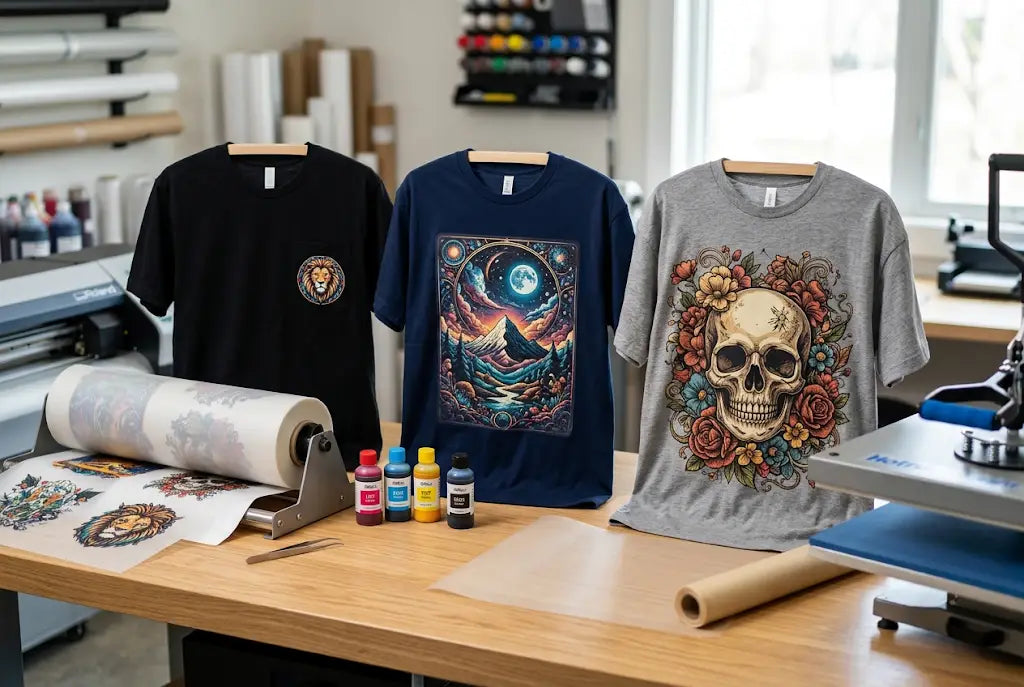
DTF transfer size is the finished width and height of your Direct-to-Film print as it will appear on the garment, measured from the outermost ink edge. If you choose size by shirt size alone, you will get prints that look too small, too big, or off-center.
Most sizing charts tell you a large needs an 11-inch print. That is only half the story. A 4-inch left chest on a large looks premium. That same 4-inch art blown up to 11 inches for a full front is a completely different product. And an oversized 13-inch streetwear print needs a different blank, different press, and different placement than a classic center chest.
In this guide we will break down exactly how to choose size by placement, not just by S, M, L. You will learn how to measure correctly, what size works for hoodies versus tees, youth versus adult, and toddler, plus the common mistakes that make a $30 shirt look cheap.
What DTF Transfer Size Really Means and Why Placement Matters More Than Shirt Size
DTF is Direct-to-Film. You print on film, you powder it, you cure it, you press it. The size you order is the size you get, with no screen to stretch or vinyl to trim. That precision is great, but it also means a bad size choice cannot be fixed on press.
How DTF Transfer Sizing Changes the Look of Your Shirt
DTF transfer sizing is not about covering fabric. It is about proportion. Our eyes read a shirt in thirds. The center chest should occupy roughly 55% to 65% of the chest width between the seams. On an adult large that is 19 to 20 inches pit to pit, so a 10.5 to 11-inch print hits that sweet spot. Go smaller at 8 inches and it looks like you were afraid to go big. Go bigger at 13 inches and you are seam to seam, which puckers on stretch and cracks over time.
Placement changes that math completely. A left chest print should never occupy more than 22% to 25% of chest width. That is why 3.5 to 4 inches works. It sits on the pectoral muscle, not in the middle of the chest. DTF transfer placement is measured from the center of the garment, not from the side seam. If you measure from the side, your left chest will drift every time the shirt size changes.
We see this mistake daily. Shops order 11-inch prints for everything because their DTF size chart for shirts says so. Then they put that same art on a youth medium and wonder why it wraps around the armpit.
Ready to Print?
Your artwork deserves sharp colors, durable prints, and fast turnaround. Place your order today and get production moving.
[ Order Your Custom DTF Prints ]
How to Measure DTF Transfer Size the Right Way Before You Print
If you measure wrong, you press wrong. And you cannot un-press DTF.
How to Measure DTF Transfer Size and Placement Like a Pro
How to measure DTF transfer size starts with two numbers, width and height, measured from the outermost ink edge, including any background. Do not measure the film. Measure the art. Film always has a clear border.
For placement, you need three measurements on the blank garment itself. First, chest width pit to pit. Second, drop from collar seam to top of print. Third, center line. Here are the numbers we use at DTF Louisville after pressing over 80,000 garments.
For adult full front, drop 3 to 3.5 inches from the bottom of the collar seam for crew necks, 2.5 inches for V-necks. For DTF transfer size for hoodies, drop 4 to 4.5 inches because the hood and neck seam are bulkier and visually push the print down. If you use the same 3-inch drop on a hoodie that you use on a tee, your print will look too high once the hood is on.
For the left chest, measure 4 inches down from the shoulder seam where the collar meets it, then 4 inches over from the center. That is your center point for a 3.5 to 4-inch print. On women's fitted tees, move it to 3.5 inches down and 3.5 over because the shoulder is narrower.
This works because you are anchoring to the body, not to the tag size. A large heavyweight blank has a 21-inch chest. A large fashion fit has 19. Same tag, different canvas.
DTF Transfer Size for Left Chest, Sleeve, and Nape Hits
Small placements are where brands look expensive or cheap.
How Big Should a DTF Transfer Be for Left Chest and Small Placements
How big should a DTF transfer be for the left chest? The industry standard that actually sells is 3.5 to 4 inches wide for adults, 3 inches for youth, 2.5 inches for toddler. Anything over 4.25 inches starts to creep toward the center chest and looks like a mistake. Anything under 3 inches gets lost, especially with thick fonts.
Sleeve hits should be 3 to 3.5 inches wide by 1.25 to 1.75 inches tall. If you go taller than 2 inches on a short sleeve, it wraps over the hem and peels. Nape or back yoke hits under the collar should be 4 to 5 inches wide, max 1.5 inches tall.
Here is what we charge and why it matters. A standard left chest transfer retails at $4.50 to $6.00 individually, but when nested on a custom DTF gang sheet with a full front, its effective cost is $0.80 to $1.20. That means you can offer a $5 add-on that costs you a dollar. Shops that do this increase average order value by 18% to 22% based on our order data.
Small prints also need thicker strokes. If your full front has 1mm thin lines, that same art at 3.5 inches will have 0.35mm lines that will not hold powder reliably. For the left chest, bump stroke weight to minimum 1.5mm and avoid text under 10pt.
DTF Transfer Size for Full Front on Tees and Hoodies
This is where most people get it right, but still waste money.
DTF Transfer Size Chart for Shirts and DTF Transfer Size for Hoodies Explained
A DTF size chart for shirts should be split into two, tees versus hoodies, because the garment construction changes the visual.
For adult tees, classic fit:
-
Extra Small to Small needs 9 to 9.5 inches wide
-
Medium to Large needs 10 to 11 inches
-
XL to 2XL needs 11 to 11.5 inches
-
3XL and up needs 11.5 to 12 inches, but keep height under 12.5 inches or you hit the belly seam
For DTF transfer size for hoodies and crewnecks, add 0.5 to 1 inch to width because hoodies have more chest room and thicker fabric that visually shrinks the print. So a large tee at 10.5 inches becomes an 11 to 11.5-inch hoodie print. Also drop your placement lower as noted earlier.
For cost, a 10x10 inch DTF transfer averages $4.50 to $5.50 from a quality supplier in 2026. A 11x11 inch is $5.50 to $6.50. That extra inch costs about $0.90 to $1.10 in film and ink. If you print oversized at 12x12 inches, you are at $7.50 to $9.00 and you also need a 16x20 press to get even pressure. A 15x15 press will leave cold edges on a 12-inch print.
Press settings matter here too. Full front at 10 to 11 inches presses at 305°F to 315°F for 12 to 15 seconds at medium pressure, around 60 psi. Peel warm after 6 to 8 seconds. Second, press 5 seconds with parchment. For hoodies at 11 to 12 inches, increase to 15 to 16 seconds because fleece holds heat and needs longer dwell.
Ready to Print?
Your artwork deserves sharp colors, durable prints, and fast turnaround. Place your order today and get production moving.
Order Your Prints
DTF Transfer Size for Youth Shirts and Toddler Shirts
Youth is not just a smaller adult. If you treat it that way, your returns will spike.
DTF Transfer Size for Youth Shirts That Actually Fits Kids
DTF transfer size for youth shirts should be 60% to 70% of adult size, not 80% like many charts say. Kids have narrower chests and shorter torsos.
- Youth Small 6 to 12 months equivalent chest 12 inches, print 6 to 6.5 inches
- Youth Small 6 to 8 years chest 14 to 15 inches, print 7 to 7.5 inches
- Youth Medium 10 to 12 years chest 16 to 17 inches, print 8 to 8.5 inches
- Youth Large 14 to 16 years chest 18 inches, print 8.5 to 9 inches
If you press an 10.5-inch adult print on a youth medium, you get 1 inch of clearance to the armpit seam. After one wash, that edge lifts because it is sitting on a seam. That is the number one reason youth prints peel.
For DTF transfer size for toddler shirts, go even smaller and simpler. Toddler 2T to 4T chest is 11 to 13 inches. Print width should be 5 to 5.5 inches max, height under 6 inches. And simplify detail. Any text under 12pt becomes unreadable at 5 inches. Any thin line under 1.2mm will not hold.
At DTF Louisville we always nest family orders on one gang sheet. Adult 10.5 inch, youth 8 inch, toddler 5.5 inch, left chest 3.5 inch. All from the same art, just scaled correctly. That way you press one sheet, fulfill one family, and you do not have four separate transfer bags to sort.
Oversized Streetwear Sizing and When Bigger Is Not Better
Oversized is trending, but oversized done wrong looks like you bought the wrong size.
When to Use Oversized DTF Transfer Size and When to Stop
Oversized prints at 13 to 14 inches wide work, but only on the right blanks. You need heavyweight 6.5oz or higher, oversized blanks like LA Apparel or Shaka Wear where the chest is 24 to 26 inches wide. On a standard 5.5oz tee at 19-inch chest, a 13-inch print is 68% coverage. It will crack in the middle because the shirt stretches more than the transfer.
Also consider height. Oversized should be 13x13 or 13x14 max. If you go 14x16, you are hitting the bottom hem on size small and the print will fold. And you must have a 16x20 press or larger. A 15x15 press cannot deliver even pressure on a 13-inch print. Edges will be under-cured and peel after 5 washes.
For DTF transfer placement on oversized, drop lower, 4 to 4.5 inches from collar, and center carefully. Oversized looks best with a boxy art style, thick fonts, minimal fine lines. It is not for photorealistic detail.
Cost wise, oversized 13x13 transfers retail $9.50 to $12.00 each, nearly double a standard 10x10. But they let you charge $45 to $55 for the tee versus $30. So margin is there if you use the right blank.
We at DTF Louisville press oversized at 300°F for 16 to 18 seconds, firm pressure 65 to 70 psi, peel warm, second press 7 seconds. And we always recommend cold wash inside-out, no softener, because oversized prints have more surface area to fail.
Conclusion: Size by Placement, Then by Blank, Then by Age
If you remember one thing from this guide, let it be this. Choose DTF transfer size by where it lives on the body first, not by what the tag says.
Left chest lives at 3.5 to 4 inches because the pectoral muscle is small. Full front lives at 10 to 11 inches on tees and 11 to 12 inches on hoodies because that is 60% of chest width. Oversized lives at 13 to 14 inches but only on heavyweight, wide blanks with a big press. Youth lives at 60 to 70% of adult. Toddler lives at 5 to 5.5 inches with simplified art.
Measure from the collar and shoulder seams, not from the side. Keep 0.25 inches between transfers on your gang sheet so you can cut clean. And always do a second press for 5 seconds.
Get this right and your shirts stop looking like transfers stuck on fabric and start looking like retail. At DTF Louisville, we build every custom sheet with true-size preview so you see the placement before we print it, which is why our reprint rate on sizing is under 1%.
Ready to Scale Your Printing Business?
Your artwork deserves sharp colors, durable prints, and fast turnaround. Place your order today and get production moving.
Frequently Asked Questions
What Is the Best DTF Transfer Size for a Full Front Adult T-Shirt?
For adult tees, use 9 to 9.5 inches for XS to Small, 10 to 11 inches for Medium to Large, 11 to 11.5 inches for XL to 2XL, and 11.5 to 12 inches for 3XL plus. Keep height under 12.5 inches to avoid the bottom hem and maintain 60% chest coverage.
How Do I Measure DTF Transfer Size for Left Chest Placement?
Measure 4 inches down from where the shoulder meets the collar and 4 inches over from center. That is your center point. Your transfer should be 3.5 to 4 inches wide for adult. For women's fitted tees, use 3.5 inches down and over, with a 3 to 3.5-inch print.
What DTF Transfer Size Should I Use for Hoodies Versus T-Shirts?
Use 0.5 to 1 inch larger for hoodies than tees because hoodies have more chest room and thicker fabric that visually shrinks art. A large tee at 10.5 inches becomes 11 to 11.5 inches on a hoodie. Drop placement to 4 to 4.5 inches below the collar seam.
How Big Should a DTF Transfer Be for Youth Shirts?
Youth prints should be 60% to 70% of adult size. Youth Small is 6 to 7.5 inches, Youth Medium 8 to 8.5 inches, Youth Large 8.5 to 9 inches. Never use an 11-inch adult print on a youth medium, it will wrap into the armpit seam and peel after washing.
What Is the Right DTF Transfer Size for Toddler Shirts?
For toddler 2T to 4T, use 5 to 5.5 inches wide and under 6 inches tall. Simplify details and avoid text under 12pt. At DTF Louisville we recommend thicker stroke weight of at least 1.2mm for toddler sizes so powder adheres cleanly and small lines do not disappear.
Does DTF Transfer Placement Affect What Size I Should Order?
Yes, placement is more important than shirt size. Left chest should be 3.5 to 4 inches, sleeve hits 3 to 3.5 inches wide, nape hits 4 to 5 inches wide. Full front is 10 to 11 inches. Oversized is 13 to 14 inches but only on heavyweight blanks with a large press.
How Do I Choose DTF Transfer Size for an Oversized Streetwear Look?
Choose 13 to 14 inches wide for oversized on heavyweight 6.5oz plus blanks with 24 to 26-inch chest width. You need a 16x20 press for even pressure. Drop placement 4 to 4.5 inches from collar. Use bold, boxy art, not fine detail, for best wash durability.
Can I Put Different DTF Transfer Sizes on One Gang Sheet?
Yes, you should mix adult, youth, toddler, and left chest sizes on one gang sheet. A 22x24 sheet can hold one 10.5-inch adult, one 8-inch youth, one 5.5-inch toddler, and two 3.5-inch chest hits. This cuts cost per print to $1.20 to $1.80 versus $5 plus individually.
What Is the Most Common Mistake When Choosing DTF Transfer Size?
The most common mistake is using one size for all garments. An 11-inch print that looks perfect on an adult large wraps into seams on a youth medium and looks tiny on a 3XL. Always scale by placement first, then by blank width, then by age group.
Does DTF Louisville Offer a DTF Transfer Size Chart for Shirts?
Yes, DTF Louisville provides a true-size preview in our gang sheet builder that shows 3.5-inch left chest, 10 to 11-inch full front, and 13-inch oversized on actual blank outlines for tees, hoodies, youth, and toddler sizes, so you can confirm size and placement before printing.
Share:
DTF Sweatshirt Print Size: Why Hoodies Need Bigger Transfers Than Tees
DTF Placement for Women's Shirts vs Men's Shirts: Size, Position, and Fit