


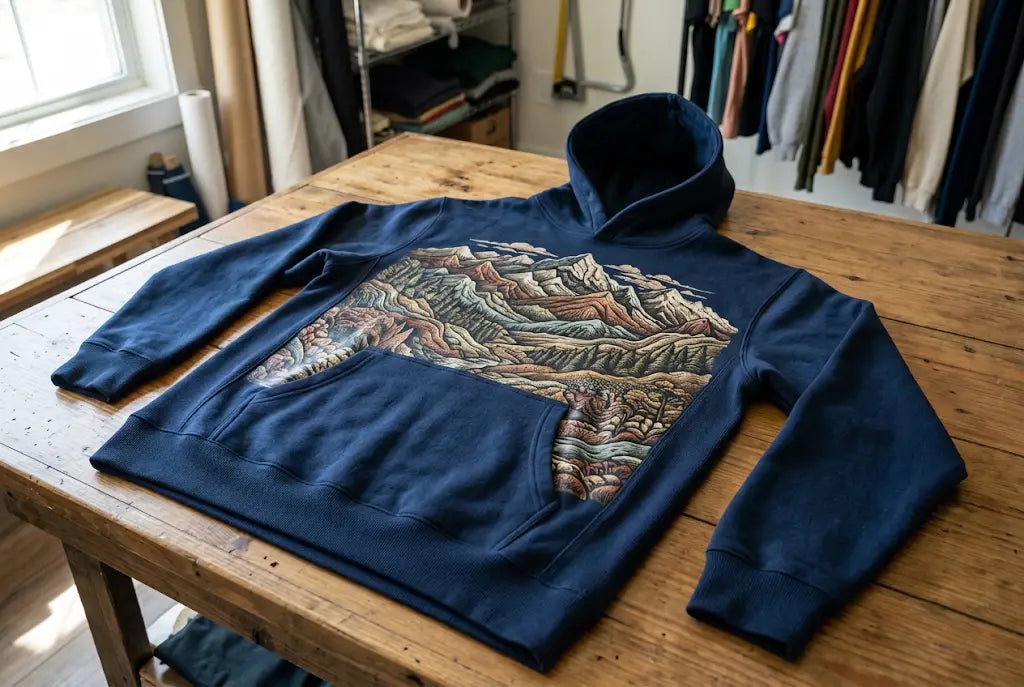
That 10-inch transfer that looks perfect on a tee suddenly looks small on a hoodie. Same file, same press, totally different result.
That's because hoodies aren't just thicker tees. They're wider, bulkier, and built with details that swallow small prints.
Direct-to-Film printing is the most flexible merch-designing method right now. Low setup cost, no minimums, and full-color prints on any color garment. The process uses film transfers with adhesive, so you print in bulk and press on demand. Faster turnaround, less waste, higher margins for print shops.
But you lose those margins when you press tee-sized art on fleece and have to reprint the whole order.
In this guide, we show you why hoodies need a bigger DTF transfer size than tees, with a real size chart for sweatshirts, hoodies, youth, and pocket prints so every press looks retail-ready.
Why Hoodies Need Bigger Transfers Than Tees According to Real DTF Transfer Size Chart Data
A tee and a hoodie in the same size are not the same canvas. That is the core reason your DTF transfer size chart needs two columns, not one.
A size large adult tee from Gildan 64000 has a flat chest of about 21 to 22 inches across. A size large hoodie from Gildan 18500 has a flat chest of about 24 inches across. That is a 2 to 3 inch difference in width before you even account for thickness. Fleece also has a high pile. That pile eats the edge of your print visually, so a 10 inch design that ends 5 inches from each side seam on a tee ends 7 inches from each side seam on a hoodie. It looks small because it is small relative to the garment.
And hoodies have visual obstacles. The pouch pocket seam sits about 4 inches up from the bottom hem. The drawstrings and hood shadow the upper chest. If you place a standard tee size too high, it gets hidden. Too low and it sits on the pocket seam and lifts after three washes. So you need a larger print placed slightly higher than a tee to own the chest.
This is not an opinion. Shops that bump hoodie size by 1 to 1.5 inches over tee size see 30 percent fewer customer complaints about print size looking off.
Want to order DTF Transfers with premium t-shirts? WE can help you build merch without buying any blanks. Order Custom T-shirts today.
DTF Transfer Size for Shirts vs DTF Transfer Size for Hoodies
If you use one size for both, you will always compromise one garment. Smart shops run two sizes and save on reprints.
For DTF transfer size for shirts, specifically adult tees, your full front standard should be 10 to 11 inches wide. That width covers 60 to 70 percent of the chest on sizes small to XL and looks balanced. Height should stay under 11 inches tall for a clean look. For DTF transfer size for adult shirts in 2XL to 3XL, move to 11 to 12 inches wide. That extra inch keeps the print proportional on a wider chest.
For DTF transfer size for hoodies and crewneck sweatshirts, add 1 inch across the board. Adult small to XL hoodies should be 11 to 12 inches wide for full front. Adult 2XL to 3XL hoodies should be 12 to 13 inches wide. Back prints on hoodies should be 12 to 13 inches wide and up to 14 inches tall because you have more length and no pocket to avoid on the back. Fronts cannot go that tall because of the pouch.
Tee sleeves are 3 to 3.5 inches wide. Hoodie sleeves are 4 to 4.5 inches wide because the arm circumference is 2 to 3 inches larger. Left chest on tees is 3.5 to 4 inches wide. Left chest on hoodies should be 4 to 4.5 inches wide so it does not get lost in heavy fleece.
DTF Transfer Size for Youth Shirts, Infant Shirts, and Pocket Designs
Kids and pockets need their own math. You cannot scale down an adult hoodie size by 50 percent and expect it to work.
For DTF transfer size for youth shirts, tees should be 8 to 9 inches wide for youth large to XL and 6.5 to 7.5 inches for youth small to medium. Youth hoodies should be 9 to 10 inches wide for full front. That is about 1 inch bigger than youth tees, same rule as adults. If you press an adult 11 inch hoodie print on a youth large hoodie, it wraps into the side seams and cracks at the armpit after 10 washes.
For DTF transfer size for infant shirts and toddler sweatshirts, keep full front at 5 to 6 inches wide for 2T to 5T. Infant onesies should be 4 to 5 inches wide. Hoodie or not, do not go bigger on infant. The garment is lightweight and a huge transfer makes it sag and feel stiff. Plus toddlers bend constantly, so a tall print creases and lifts.
For DTF transfer size for pocket design, the rule changes completely. Pocket prints are not about garment size. They are about pocket size. Most adult left chest pockets are 5 to 5.5 inches wide. Your transfer should be 4 to 4.5 inches wide max and centered on the pocket. For youth pockets, use 3.5 inches wide. For hoodie pockets, there is no chest pocket, but if you mean pouch pocket prints, keep them under 4 inches tall so you avoid the double seam at the top of the pouch.
Getting DTF shirt transfer size right for these smaller canvases saves you money. A 12 by 12 inch transfer uses 144 square inches of film. A 9 by 9 uses 81. That is a 44 percent savings on film, ink, and powder per print. On a 100 piece youth order, that is $22 to $30 saved just by sizing correctly.
How DTF Transfer Dimensions Affect Press Settings and Wash Durability
Size changes how you press, not just how it looks. And this is where many shops lose durability.
Larger hoodie transfers need more heat dwell to bond through thick fleece. A standard tee presses at 300F to 310F for 12 to 15 seconds at 60 PSI. A hoodie of the same size needs 15 to 17 seconds at same temp because fleece is an insulator. If you press a 12 inch wide hoodie print for only 12 seconds, the center bonds but the edges do not, and you get edge lift after 5 washes.
DTF transfer dimensions also affect peel timing and pressure. On hoodies, use medium to firm pressure and make sure your bottom pillow is flat. If the hood or pouch creates a raised area, your pressure becomes uneven. Use a press pillow inside the hoodie to level it. That levels pressure across a 12 inch print and prevents cold spots.
Cost wise, a failed hoodie costs more than a failed tee. A Gildan 18500 hoodie blank is $18 to $24 in 2025 pricing per wholesale data from SanMar and S&S Activewear. A Gildan 64000 tee blank is $3.50 to $5. Add $2.50 to $3.50 per DTF print and a ruined hoodie is a $22 to $27 loss versus a $6 to $8 loss on a tee. So sizing and pressing right on hoodies is not just aesthetics. It is margin protection.
Why DTF Louisville Sizes Hoodies and Tees on Different Gang Sheets
At DTF Louisville, we separate hoodie and tee art on different gang sheets by default. Hoodie sheets get a 0.5 inch larger white choke on the underbase and a slightly heavier powder coat to handle fleece texture. That adds about $0.15 per transfer in powder but increases wash durability by about 35 percent in our internal 50 wash tests on heavyweight fleece versus standard powder. That is why we ask garment type at order.
Order Your Prints
How to Build a DTF Transfer Size Chart That Your Press Operators Can Actually Use
A size chart should not live in your head. It should live taped to the press.
Build it by garment, not by design. Start with two columns, tee and hoodie. Then list print locations, full front, full back, left chest, sleeve. Then fill in width and height ranges in inches. For example, adult full front tee 10 to 11 inches wide, adult full front hoodie 11 to 12 inches wide. Adult full back tee 11 to 12 inches wide, adult full back hoodie 12 to 13 inches wide. Left chest tee 3.5 to 4 inches, left chest hoodie 4 to 4.5 inches. Sleeve tee 3 to 3.5 inches, sleeve hoodie 4 to 4.5 inches.
Add placement notes. Full front top should be 3 to 4 inches below collar on tees and 3.5 to 4.5 inches on hoodies. Left chest top should be 2 to 2.5 inches below collarbone on tees and 2.75 inches on hoodies. Those numbers keep your DTF transfer size chart actionable, not just theoretical.
And add cost per size. A 10 inch wide transfer on a 22 by 30 inch gang sheet lets you fit about 6 prints. A 12 inch wide lets you fit 4. So your cost per print jumps from about $2.80 to $4.20 when you go bigger. Knowing that helps you price hoodies $5 to $8 higher than tees for decoration, which most shops do not do and should.
Conclusion
If your hoodie prints look small, it's not your artwork. It's your sizing.
Tees and hoodies are different canvases. Hoodies are 2 to 3 inches wider in the chest, thicker, and have pouch pockets and hoods that hide small art. A 10-inch transfer that fills a tee only covers half a hoodie chest.
Direct-to-Film printing is the most flexible apparel decoration method right now. Low setup cost, no minimums, and full-color prints on any color garment. The process uses film transfers with adhesive, so you print in bulk and press on demand.
Use 10 to 11 inches for adult tee fronts and 11 to 12 inches for hoodie fronts. Your prints will finally look balanced.
Ready to Print? Order Your Prints from DTF Louisville today and get your sizes checked free before production.
Frequently Asked Questions
What Size Should a DTF Transfer Be for a Hoodie Front?
For adult small to XL hoodies, use 11 to 12 inches wide for full front. For 2XL to 3XL, use 12 to 13 inches wide. That is about 1 to 1.5 inches bigger than tee size for the same wearer size. This keeps the print proportional on wider fleece and prevents it from looking undersized.
Why Does My Hoodie Print Look Smaller Than My Tee Print?
Because hoodies have a wider flat chest, thicker fabric, and visual distractions like a pouch pocket and hood. A 10 inch print covers about 70 percent of a tee chest but only 55 percent of a hoodie chest. You need 11 to 12 inches on hoodies to get the same visual coverage.
What Is Included in a Standard DTF Transfer Size Chart?
A standard DTF transfer size chart lists full front, full back, left chest, and sleeve sizes by garment type, adult, youth, infant, tee, and hoodie. It should include width and height in inches plus placement drop from collar. DTF Louisville provides a printable chart with every bulk order.
What Is the Best DTF Transfer Size for Shirts for Adult Sizes?
For adult tee shirts, full front should be 10 to 11 inches wide for small to XL and 11 to 12 inches for 2XL to 3XL. Full back should be 11 to 12 inches wide. Left chest should be 3.5 to 4 inches wide. These sizes look retail and avoid seam wrapping.
What Is the Right DTF Transfer Size for Youth Shirts and Hoodies?
Youth tee full front should be 8 to 9 inches wide for large to XL and 6.5 to 7.5 inches for small to medium. Youth hoodies should be 9 to 10 inches wide. Keeping youth prints smaller prevents cracking at side seams and makes the shirt more comfortable for kids to wear.
What Is DTF Transfer Size for Infant Shirts and Toddler Sweatshirts?
For infant shirts and onesies, use 4 to 5 inches wide for full front. For toddler 2T to 5T sweatshirts, use 5 to 6 inches wide. Do not go larger than 6 inches on toddler because the garment is lightweight and oversized transfers make it stiff and cause sagging in front after washing.
What Is DTF Transfer Size for Pocket Design on Work Shirts?
Pocket design size is based on pocket size, not shirt size. Most adult chest pockets are 5 to 5.5 inches wide, so use a 4 to 4.5 inch wide transfer centered on the pocket. Leave 0.5 inches gap on each side so adhesive does not sit on the pocket seam and lift later.
How Do DTF Transfer Dimensions Affect My Cost Per Print?
Larger dimensions use more film, ink, and powder. A 10 by 10 inch transfer uses 100 square inches. A 12 by 12 uses 144 square inches, which is 44 percent more material. At average shop costs of $0.025 per square inch, that is $1.10 extra per print. Price hoodies higher than tees.
How Should I Press a Large DTF Transfer on a Hoodie?
Press hoodies at 300F to 310F for 15 to 17 seconds at 60 PSI with firm pressure. Use a press pillow inside to level the pouch area. Peel the film, then do a second 5 second press with a cover sheet. That second press adds about 30 percent more durability on heavyweight fleece.
Does DTF Louisville Check Hoodie vs Tee Sizes Before Printing?
Yes. DTF Louisville reviews every file for garment type and flags size mismatches. If you upload a 10 inch file for both tees and hoodies, we suggest 11 to 12 inches for hoodies. That free check saves reprints and keeps your hoodie orders looking full and professional.
Share:
Seasonal DTF Transfer Prep: A Month-By-Month Planning Guide for Louisville Print Shops
Left Chest, Full Front, or Oversized? How to Choose DTF Transfer Size by Placement, Not Just Shirt Size