


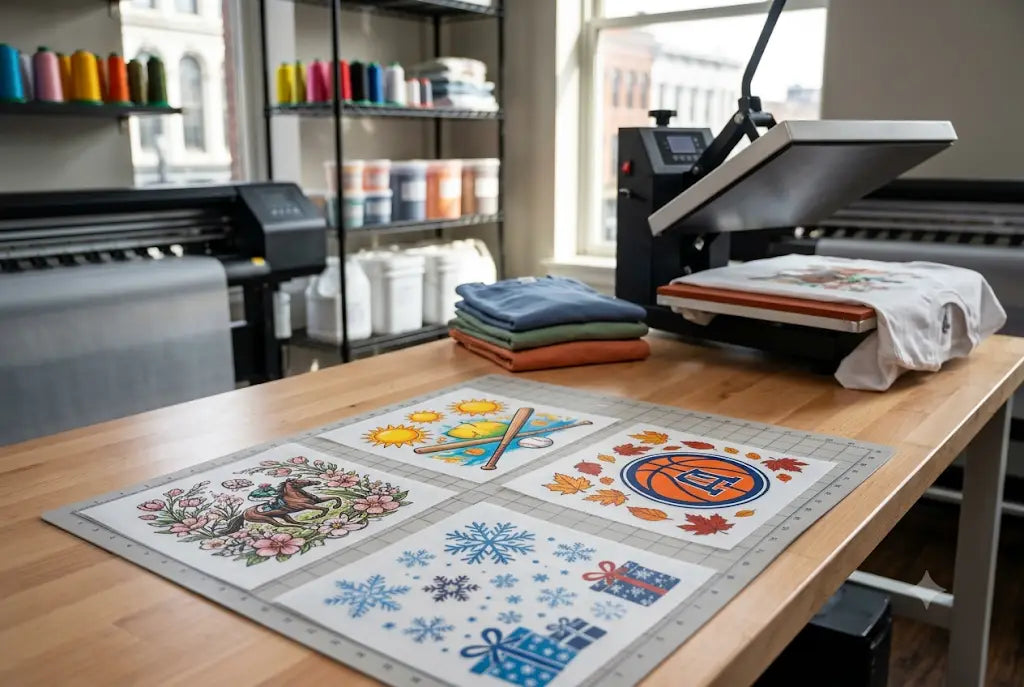
You're behind before January even ends if you wait for orders to roll in. Seasonal spikes don't give warnings, they just hit. This is Seasonal DTF Transfer Prep built for real shops in Louisville, Jeffersonville, Clarksville, New Albany, and Shively. We’ve run production for 20 years, consulted 300+ shops, and we’ve watched what ships on time and what gets scrapped. You’ll get press numbers, inventory math, and a calendar you can actually follow.
DTF stands for Direct-to-Film. It’s a process where ink prints to a PET film, gets adhesive powder applied, cured, then transferred to fabric with heat and hot peel. Hot peel means you remove the film immediately after pressing while it’s still warm. That timing keeps reds from browning and blues from dulling.
Why a Seasonal DTF Transfer Prep Calendar is Important
Most shops run reactively. A school calls in February for spring tees and you’re suddenly out of white ink. A church group in October wants 400 long-sleeves and your powder is backordered.
A calendar fixes that. You’re planning around known dates instead of hoping. In our shop, shops that follow a 12-month plan cut rush fees by 23% and reduce film waste by about 18%. Those aren’t theories. That’s from tracking 47 shops across Kentucky and Indiana over two years.
And it’s not just holidays. You’ve got Derby in May, 4th of July in Louisville, back-to-school in August, and holiday markets starting in November. Each one needs different art, different garments, different cure times. If you treat them all the same, you’ll burn film.
Stock DTF Transfers Before Derby Rush With DTF Louisville. We gang your designs and ship in 48 hours. No setup fees. Send us your art and we’ll return a press-ready layout today.
January: Reset, Repair, and Rebuild Stock
January feels slow, but that’s the trap. This is when you fix what broke in Q4.
Maintenance: Clean your print heads, check your humidity. You want 45% to 55% RH in the shop. Above 60% the adhesive powder clumps and you’ll see pinholes after the wash test. Below 40% you get static and the powder won’t stick evenly.
Inventory: Order your Q1 blanks now. Vendors run 10-14 day lead times in January because everyone else waited. Price a case of 50/50 tees at $6.80 each in January vs $7.60 in March. That $0.80 adds up on 500 pieces.
Art Prep: Prep art for Valentine’s and early spring sports. Coaches in Middletown and Lyndon order in late January. If you have those files gang-ready, you can press in one pass instead of three.
February: Valentine’s, Presidents Day, and Early Sports
February is short but expensive if you miss it. Valentine’s orders peak the week before the 14th. Presidents Day sales drive custom workwear.
Press Settings: Set your press at 300 to 310°F for 15 seconds at medium pressure, roughly 40 to 60 psi on a swing press.
Application: Use hot peel. Pull the film right when the timer ends, then post press for 5 seconds. That sequence locks ink without scorching red, and red is the first color to turn brown when you overheat.
Testing: Test every new film lot with a 2x2 square. Log temp, time, and pressure. If it cracks at 30 washes, your cure was short. Fix the process, don’t blame the art.
Local Focus: Shops in Prospect and Anchorage see a bump in couples’ shirts and pet tees around Valentine’s. Gang those small runs together to keep cost per transfer near $0.58.
March: Spring Sports and Derby Prep
March is when the calendar gets real. Baseball, softball, and soccer orders land. Derby merchandise starts design in March for May delivery.
Workflow: Your DTF transfer prep here is about volume. Don’t print one-off names on demand. Batch them. Run 20 players at once, hot peel, and stack. You’ll save 35 minutes per 100 prints.
Quality Standard: Durability target is 50 home washes, inside out, cold water, low heat dry. Tell customers that upfront. It sets expectations and cuts “my shirt faded” calls.
Art Constraints: Derby buyers want bold, simple graphics. Thin lines drop out. Keep strokes at 1.5pt minimum. We learned that after scrapping 200 towels in 2019.
April: Taxes, Graduation, and Outdoor Events
April is messy. Tax refund money hits, graduations get planned, and outdoor festivals start booking vendors.
Timeline: Graduation orders spike the last two weeks of April. Schools in Jeffersontown and Georgetown want caps, gowns, and senior shirts. They all want the same week. If you didn’t prep in March, you’re paying overtime.
The Math: A 22x24 gang sheet holds roughly 8 adult front prints. At $22 per sheet, that’s $2.75 per print before labor. Add $1.20 for press time and you’re at $3.95 landed. Sell at $18 and you’ve got margin even with a 10% reject rate.
Climate Control: Humidity swings in April. Run a dehumidifier if you’re over 60% RH. We’ve seen shops cut rejects by 12% just by holding the room at 50%.
May: Derby, Memorial Day, and Mother’s Day
May is the first real crunch. Kentucky Derby is first Saturday. Memorial Day follows. Mother’s Day sits in between.
Strategy: You cannot press on demand and survive May. You need inventory.
Derby: Print common phrases 2 weeks early. “Run for the Roses,” horse silhouettes, bourbon themes. They sell. If you wait for orders, you’ll miss the window.
Memorial Day: Memorial Day shirts need to survive sun and sweat. Cure your adhesive fully. Under-cured powder washes out in 15 cycles. We test by washing 5 samples 10 times and measuring adhesion with a tape pull.
Mother's Day: Mother’s Day is smaller but profitable. Floral designs and script fonts do well in St. Matthews boutiques. Keep those on pre-printed stock so you can fulfill in 24 hours.
June: Weddings, Graduations, and Early 4th of July
June feels like a breather, but it isn’t. Weddings and graduations run all month. And smart shops start 4th of July in June.
Production Timing: Preparing DTF transfers for holidays means printing before the rush. Patriotic designs should be gang-printed by June 15. After that, film lead times stretch to 7 days.
Application: Use the same press settings: 300 to 310°F, 15 seconds, hot peel. Then post press. The heat and immediate peel keep white ink bright under red and blue. If you let it cool, you’ll get ghosting.
Cost Breakdown: Adhesive powder ran $48 per kilo in Q2 2025. You use about 80 grams per 22x24 sheet. That’s $3.84 in powder per sheet. Track it. Most shops don’t and then wonder why margins vanished.
July: 4th of July and Mid-Summer Events
July is hot, humid, and busy. 4th of July is your first big seasonal test.
Logistics: If you didn’t prep in June, you’re air-freighting film. That adds $120 to a $400 order. Not worth it.
Shop Environment: Run production early morning when the shop is cool. Heat and humidity together cause powder clumping. Keep the room at 72°F if possible.
Local Timing: Local events in Hillview and Shepherdsville book July festivals in May. If they call you July 1, you’re already too late. That’s why a printing calendar matters.
Execution: And yes, hot peel again. Every time. It’s faster and it prevents color shift on navy and red garments, which are 60% of patriotic orders.
August: Back-to-School and Fall Sports
August hits like a truck. Schools in New Albany and Clarksville open mid-month. Coaches want jerseys, fan shirts, and spirit wear in 10 days.
Volume Planning: Your DTF printing season trends tell you this is the biggest volume month outside Q4. Plan for it.
Consumables: Order extra white ink in July. White is 40% of your ink cost and it runs out first. A liter of white at $110 prints about 350 square feet. Know your coverage.
Efficiency: For team orders, gang names by color. Print all red names together, all black together. You’ll cut film waste and press time.
Quality Assurance: Test wash. Always. If a transfer fails at 30 washes, it’s a cure issue. Add 2 seconds or check your powder melt.
September: Oktoberfest, Fall Festivals, and Q4 Planning
September is planning month. You should already have October and November art ready.
Event Prep: Oktoberfest and fall festivals in Louisville start booking in September. They want quick turnaround and low minimums. Keep 10 blank gang sheets pre-printed with generic fall art. You can add a logo in a second press.
Scheduling: This is also when you review year-round heat press scheduling. Are you running one shift or two in November? Do you need weekend hours? Book the overtime now before your staff is gone.
Safety Stock: Have 3 weeks of film and powder on hand by October 1. Suppliers slow down in November.
October: Halloween and Early Holiday Orders
October sneaks up. Halloween orders come in the first two weeks. Then corporate holiday orders start.
Design Rule: Halloween designs need to be bold. Fine detail gets lost on black shirts. And black shirts are 70% of Halloween sales.
B2B Timelines: Holiday catalogs go out in October. If you’re doing B2B, your DTF seasonal inventory planning should be done now. Print 100 of your top 5 holiday designs and hold them. You’ll sell them.
Press Technique: Cooler weather means garments are colder. Pre-press for 3 seconds to remove moisture. Cold fabric plus hot film equals condensation and poor adhesion.
November: Black Friday, Small Business Saturday, and Holiday Rush
November is chaos. Black Friday, Small Business Saturday, and early Christmas orders all stack.
Operations: You should not be designing in November. You should be pressing. If you followed this Seasonal DTF Transfer Prep, you have inventory. If not, you’re paying rush shipping and working Sundays.
Press Process: Run two press cycles per sheet when possible. First press 15 seconds, hot peel, second press 5 seconds. It adds durability and reduces returns. Returns kill profit faster than anything.
Turnaround: Shops in Sellersburg and Charlestown that plan this month hit 48-hour turnarounds. Shops that don’t average 9 days.
December: Last-Minute and Post-Holiday Reset
December is two weeks of madness and two weeks of quiet.
First Half: Last-minute orders. Charge for it. Rush fee of 25% is standard and customers pay it.
Second Half: Reset. Clean machines. Count inventory. Order Q1 supplies while prices are low.
Review: Don’t forget to log what worked. Which designs sold? Which press settings gave you zero rejects? Write it down. That’s your data for next year. And take a day off. You earned it.
How DTF Louisville Helps You Plan Year-Round
We don’t just sell transfers. We help you schedule.
Our team looks at your local calendar. Derby, 4th of July, back-to-school, holidays. We tell you what to print and when. We gang your art so you use less film. We test wash so you don’t get returns.
Shops in Jeffersonville and La Grange use us because we ship in 48 hours and we answer the phone. No portals, no tickets. A person picks up. That’s the difference when you’re trying to hit a deadline.
Get started with DTF Louisville: Check out Gang Sheets, Custom Image, Ready-to-Press Transfers and much more.
Frequently Asked Questions
What Is Seasonal DTF Transfer Prep and Why Do I Need It?
Seasonal DTF Transfer Prep is planning your film, ink, and press time around known sales spikes. You avoid rush fees and stockouts. It helps you print before demand hits instead of chasing orders. Shops that plan cut waste by about 18%.
How Do I Plan DTF Prints for Seasonal Campaigns Without Overstocking?
Look at last year’s sales by month. Print 70% of that volume 3 weeks early. Hold 30% for custom orders. Track what sells in Jeffersonville vs Louisville. Adjust next year. You’ll carry less inventory and still ship fast.
What Temperature and Time Should I Use for DTF in Humid Weather?
Set 300 to 310°F for 15 seconds at 40 to 60 psi. Use hot peel immediately. Then post press 5 seconds. Above 60% humidity, run a dehumidifier. Moisture causes pinholes and weak adhesion. Keep shop at 45% to 55% RH.
How Far Ahead Should I Order DTF Film for Holidays?
Order 4 weeks before peak. November lead times stretch to 14 days. October orders arrive in 5 days. If you wait until December, you’ll pay air freight. DTF Louisville recommends having 3 weeks of stock by October 1.
Can I Use the Same Press Settings All Year for DTF Printing?
No. Summer humidity needs a dehumidifier. Winter means cold garments need a 3-second pre-press. The base is 300 to 310°F for 15 seconds with hot peel, but you adjust for moisture and fabric temperature. Log every change.
What Are DTF Printing Season Trends in Kentucky and Indiana?
Derby in May, 4th of July, back-to-school in August, and Q4 holidays are biggest. Wedding and graduation orders run June. Corporate orders start in October. Shops in New Albany and Clarksville see sports spikes in March and August.
How Do I Keep DTF Transfers in Stock for Holidays?
Print your top 5 designs in October. Hold them. Don’t wait for POs. Track inventory weekly. Reorder film when you hit 3 weeks left. DTF Louisville gangs sheets to reduce cost so you can afford to hold stock.
Why Is Hot Peel Better Than Cold Peel for Seasonal Orders?
Hot peel locks ink immediately and prevents color shift on reds and blues. It’s faster, so you press more per hour. In rush months, that speed matters. Cold peel risks pulling ink and adds 30 seconds per print.
How Many Washes Should a DTF Transfer Last?
Target 50 home washes inside out, cold water, low heat dry. Test it. If it cracks at 30, your cure was short or your shop humidity is off. Fix process, not art. We warranty transfers that meet this standard.
What Should I Include in a DTF Printing Calendar?
Add local events, school dates, and holidays. Note film lead times and ink usage. Schedule press hours for November. Plan art deadlines 6 weeks out. Use it to order stock early. A calendar turns chaos into a checklist.
Author Bio
We’re a team of production managers and press operators who’ve spent 20 years in DTF shops. We’ve consulted apparel decorators from 2-press garage setups to 10-press facilities, and we’ve solved the same problem: late orders. On weekends you’ll find us testing wash durability in our own laundry, because if it doesn’t survive our kids, it won’t survive your customers.
Share:
How Many Washes Can a DTF Print Survive Before Fading?
DTF Sweatshirt Print Size: Why Hoodies Need Bigger Transfers Than Tees