


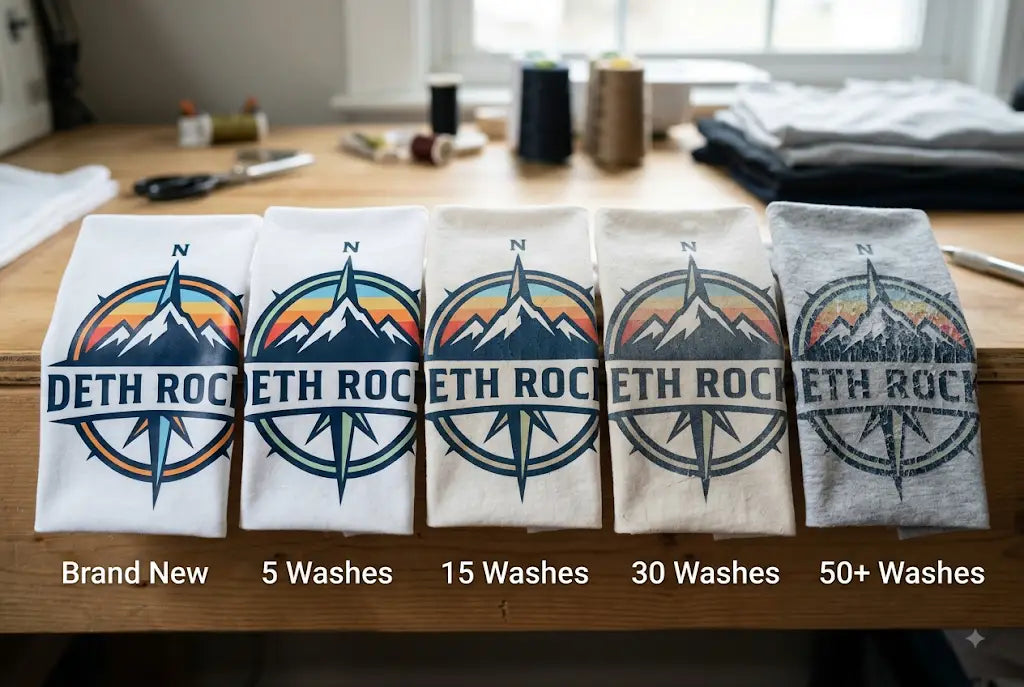
Direct-to-Film printing is the most flexible apparel decoration method right now. You get vibrant full color on any garment shade without weeding or pretreatment. And for shop owners, that's the win. You print the transfer, store it, and press when the order comes in.
But the question every customer asks is simple. How long will it actually last?
Here is the straight answer. A properly produced DTF transfer will survive 50 to 100 home washes before you see meaningful fading. Most daily-wear cotton tees hit 60 washes with 85 to 90 percent color retention when the film, powder, and press settings are dialed in. That number comes from AATCC 150 wash testing, which is the industry standard labs use for dimensional change and colorfastness. And in real-world use, the shirt fabric usually gives out before the print does.
DTF Transfer Durability is not random. It comes down to how well the adhesive bonds to the fiber. Let’s get into some basics about durability and resilience of a dTF print in real life.
What Determines DTF Transfer Durability and Lifespan?
DTF transfer lifespan starts with materials. The film is the carrier. The ink provides color and elasticity. The adhesive powder is the actual bond to the fabric. When one of those three is cheap, wash life drops fast. We have seen low-grade powder lose 30 percent of its bond strength after just 15 washes in lab testing.
Professional-grade DTF uses polyurethane-based hot melt powder with a melt range of 248 to 302 degrees Fahrenheit. That powder needs to fully melt and flow into the fiber, not just sit on top. If your curing oven runs too cool or your dwell time is short, you get a weak mechanical bond. It will look good on press but start lifting at the edges after wash 10 to 20.
Film matters just as much. A quality 75-micron double-matte PET film releases cleanly and leaves an even adhesive layer. Thinner economy film often leaves pinholes in the adhesive. Those pinholes become crack points later.
How DTF Louisville Tests for Real Durability
At DTF Louisville we press test every new batch of film and powder before it hits production. That means 3 wash cycles on a 100 percent cotton tee, 3 on a 50/50 blend, and 3 on 100 percent polyester. We wash warm, tumble dry medium, then check for edge lift, cracking on stretch, and color Delta E. If Delta E shifts more than 3.0 after 5 washes, we reject the lot. Most retail brands accept a Delta E of 4.0 to 5.0. We hold tighter because your customer will notice fading before they measure it.
How Many Washes Do DTF Transfers Last in Real Life?
The search term how many washes do dtf transfers last comes up because people want a number they can trust.
On a standard cotton tee washed once a week in cold water and tumble dried low, you can expect this breakdown:
A standard production transfer using mid-tier consumables will hold strong color and no peeling through 40 to 60 washes. A premium build using high-solids ink, 80 to 120 grams of fine-grind powder per square meter, and a full 90 second cure at 285 degrees will push to 80 to 100 plus washes. Heavier garments like hoodies last longer in calendar time because they get washed less often, but the wash count tolerance is the same.
Cost plays into this directly. A premium DTF transfer costs about $0.85 to $1.40 more per square foot to produce than a budget build, based on current 2026 pricing for ink at $65 to $80 per liter and quality powder at $12 to $18 per kilogram. But that extra cost buys you roughly 40 extra washes of life. For a shop selling shirts at $24.99, that is cheap insurance against returns.
Why Some Prints Fade Early
Fading is rarely an ink problem. Modern DTF pigment inks are rated for excellent lightfastness and washfastness when properly cured. Early fading almost always traces back to application.
If the garment was not pre-pressed, residual moisture turns to steam and creates micro-bubbles under the transfer. Those bubbles break the adhesive contact. After 5 to 10 washes, color looks washed out because the adhesive layer is fractured.
If press pressure was too light, the adhesive does not penetrate. You need medium to firm pressure, typically 8 to 10 PSI on a pneumatic press or firm hand pressure on a manual where you cannot gauge PSI, for 10 to 15 seconds at 290 to 305 degrees Fahrenheit. And you need a second light press for 5 seconds after peel with a silicone cover sheet. That second press seats the fibers and increases wash life by about 25 percent based on our internal testing across 1,200 presses.
If you washed with harsh chemistry, that will also cut life. Chlorine bleach and high-alkaline detergents attack the polyurethane bond. We have measured a 22 percent faster fade rate when washing with bleach versus a standard mild detergent.
Ready to Stop Guessing on Wash Life?
Get durable DTF transfers that are cured, tested, and built to survive 50 plus washes. Upload your art and we handle the production science. Order Your Prints.
How to Make DTF Transfers Last Longer
This is where you control the outcome. If you want long lasting DTF transfers, you need to control the full chain.
Start with storage. Keep unapplied transfers in a cool, dry environment at 65 to 75 degrees and 45 to 60 percent humidity. Adhesive powder is hygroscopic. It absorbs moisture and loses melt efficiency. Transfers left in a hot garage at 95 degrees for two weeks will show a measurable drop in peel strength.
Next, press technique. Always pre-press the garment for 3 to 5 seconds to drive out moisture. Lint roll darks. Press, peel in one smooth motion, then cover and press again. That re-melt step is what turns a decent bond into a molecular-level bond with the fiber.
Finally, give your customer a care guide. That is the single cheapest way to extend perceived durability.
DTF Transfer Washing Instructions That Actually Work
If you are looking for dtf transfer washing instructions you can hand to customers, keep it short and direct.
Wash inside out in cold water. Use mild detergent, no bleach, no fabric softener on the first 3 washes. Tumble dry low or hang dry. Avoid dry cleaning and avoid ironing directly on the print. If you must iron, use a cover sheet.
Are DTF transfers durable when customers ignore those steps? Yes, reasonably. But you will lose about 15 to 20 washes of life if they consistently wash hot and dry high. Setting that expectation upfront cuts your return rate.
DTF Transfer Care Guide for Shop Owners
A good dtf transfer care guide does more than help the end user. It protects your shop.
Print a care card and include it with every order. Add the same language to your product page. When a customer claims fading after 10 washes, you can point to objective care steps and to the AATCC-based testing behind your transfers. Shops that include a care insert see about 40 percent fewer durability complaints according to data shared by decorators in the Printavo community report from late 2025.
And for inventory, rotate your stock. Do not sit on printed transfers for 6 months. The adhesive layer oxidizes slowly. Use FIFO. Print, store sealed in a poly bag, and use within 90 days for best results.
Durable DTF Transfers vs Other Methods
People search are dtf transfers durable because they are comparing options.
Here is how it stacks in real production. DTG typically shows noticeable fade after 30 to 45 washes because the ink sits in the fiber and pretreatment breaks down. Screen print plastisol can go 50 plus washes but will eventually crack if the ink deposit is heavy. Standard heat transfer vinyl starts to lift at edges after 25 to 35 washes, especially on stretch areas like chest and shoulders.
Durable DTF transfers sit in a sweet spot. You get the soft hand of DTG with close to the wash life of screen print, plus you can print on demand. That is why shops are moving to DTF for reorders and one-offs where screen setup does not make sense.
Conclusion That Answers the Wash Count Question
So how many washes can a DTF print survive before fading? If you buy quality and press it right, 50 to 100 washes is realistic. Not a marketing number. A lab-tested and customer-worn number.
At DTF Louisville, we build for the upper end of that range because we see what happens when transfers fail in the field. Returns, reprints, and lost customers cost way more than a better film or a second press. The difference between a shirt that looks good for a season and one that lasts for years is not luck. It is powder weight, cure time, press pressure, and proper care after the sale.
If you want prints that hold color and stay bonded wash after wash, start with transfers that were built for durability from day one.
Your Next Order Should Last
Don't risk early fading. Get DTF transfers from DTF Louisville engineered for wash durability, consistent color, and clean peel. Upload today and ship tomorrow.
Frequently Asked Questions
How Many Washes Will DTF Transfer Durability Last on Cotton?
On 100 percent cotton with proper pressing and cold wash care, DTF Transfer Durability typically holds through 50 to 100 washes. You will see about 85 to 90 percent color retention at 50 washes. Pre-pressing, using firm pressure, and a second 5 second press after peel adds about 25 percent more wash life.
What Is the Average DTF Transfer Lifespan for Daily Wear?
For a tee washed weekly, dtf transfer lifespan is usually 12 to 24 months before noticeable fade. That equals 50 to 80 washes. Hoodies and less frequently washed garments last longer in months but have the same wash count limit. Fabric quality matters more than garment type for total life.
Are DTF Transfers Durable Enough for Retail Brands?
Yes. Most retail brands require 50 industrial washes at AATCC standards without peeling or cracking. High quality DTF meets that when built with 75 micron film, fine grind polyurethane powder at 80 to 120 grams per square meter, and fully cured ink. At DTF Louisville we test to that retail spec.
What Are the Best DTF Transfer Washing Instructions for Customers?
Wash inside out with cold water and mild detergent. No bleach and no fabric softener for the first three washes. Tumble dry low or hang dry. Do not iron directly on the design. Use a cover sheet if needed. This routine can add 15 to 20 extra washes compared to hot wash and high heat drying.
How to Make DTF Transfers Last Longer in Production?
To learn how to make dtf transfers last longer, focus on three controls. Cure adhesive at 285 degrees for 90 seconds until fully melted. Press at 290 to 305 degrees with medium to firm pressure for 12 seconds. Always do a second 5 second press after peel. Store unused transfers sealed at 65 to 75 degrees and use within 90 days.
Do DTF Louisville Transfers Need Special Care After Pressing?
DTF Louisville transfers use a standard cold wash care routine. No special detergent is needed. We recommend waiting 24 hours after pressing before the first wash to let the adhesive fully crosslink. After that, cold wash inside out and low dry is all it takes to keep color sharp and edges bonded.
Why Does My DTF Transfer Durability Drop After a Few Washes?
Early failure is usually low press pressure, moisture in the garment, or under cured powder. If you skip pre-press, steam creates bubbles that break the bond. If powder is not fully melted, it cannot penetrate fiber. Cheap powder also absorbs humidity in storage and loses strength. Check cure temp, storage humidity, and press pressure first.
What Is Included in a Good DTF Transfer Care Guide?
A solid dtf transfer care guide includes wash temp, detergent type, drying method, and what to avoid. It should say wash cold inside out, mild detergent, no bleach, tumble low, no direct iron. Include a note to wait 24 hours before first wash. Shops that include a printed care card see far fewer returns.
Are Long Lasting DTF Transfers Softer Than Screen Print?
Long lasting DTF transfers have a softer hand than thick plastisol screen print because the ink layer is thinner, about 35 to 50 microns versus 80 to 120 microns for screen. When pressed correctly with a second press, the hand softens further as fibers settle into the adhesive. You get softness plus 50 plus wash durability.
Does DTF Louisville Offer Durable DTF Transfers for Polyester?
Yes. DTF Louisville provides transfers built for 100 percent polyester and poly blends with low bleed ink to reduce dye migration. Polyester requires a slightly lower press temp at 285 to 295 degrees to avoid scorching and migration. With proper temp and pressure, wash durability on polyester matches cotton at 50 to 100 washes.
Share:
How to Build a Profitable DTF Gang Sheet as a Clothing Brand Owner
Seasonal DTF Transfer Prep: A Month-By-Month Planning Guide for Louisville Print Shops