


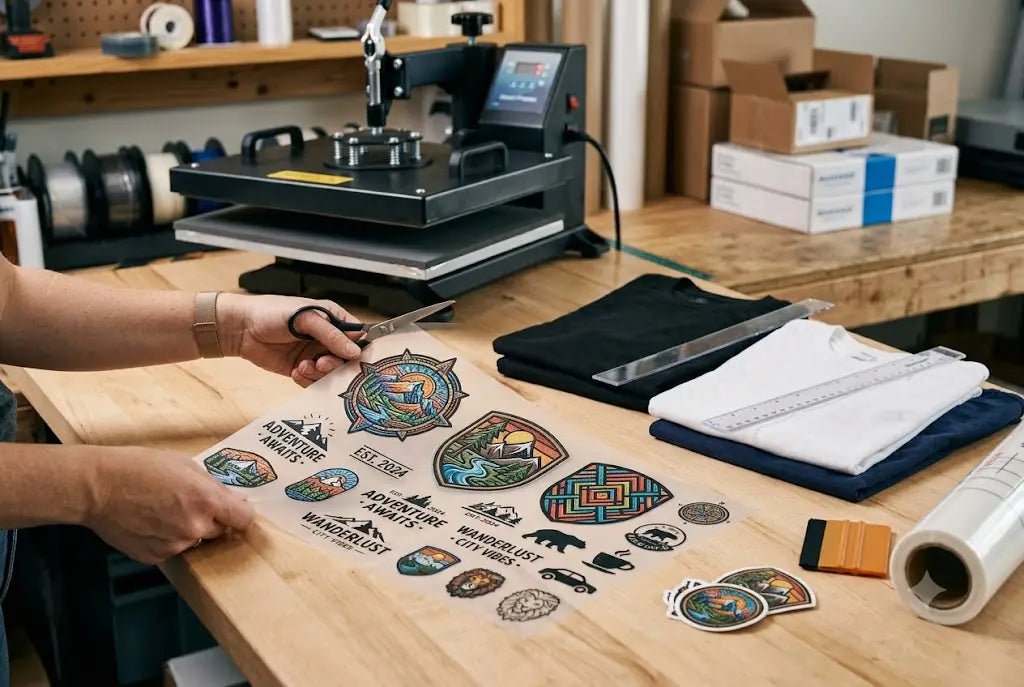
If you print more than 1,000 units a week, your DTF gang sheets are not just supplies. They are your biggest cost lever. A small waste on one sheet does not matter much. The same waste on 40 sheets a week costs you thousands every month.
Direct-to-Film printing is the most flexible apparel decoration method right now. Low setup cost, no minimums, and full-color prints on any color garment. The process uses film transfers with adhesive, so you print in bulk and press on demand. Faster turnaround, less waste, higher margins for print shops. But when you press 1,000 shirts a week, even $0.20 extra cost per shirt is $200 a week. That is $10,400 a year gone. This guide shows you step by step how to build DTF gang sheets that save money at high volume.
Why DTF Gang Sheets Cost More When You Print 1,000 Units a Week
When you print 1,000 units a week, you use a lot of film. Let's do simple math. One 22x60 sheet gives you about 10 large prints or 50 small chest logos. To make 1,000 shirts with large prints, you need 100 sheets a week. At $24 retail per sheet, that is $2,400 a week just for film. At wholesale, that same 100 sheets at $15 each is $1,500 a week. You save $900 a week just on price. That is $46,800 a year.
But price is only half. The other half is waste. Most shops waste 20% to 30% of every sheet because of bad layout. At 1,000 units a week, 25% waste means you buy 25 extra sheets you did not need. At $15 each, that is $375 a week in trash. That is $19,500 a year in film you threw away.
How Much Money You Lose on Bad Layouts
Let's say your left chest logo is 4x4 inches. With good spacing, you fit 55 per sheet. Cost per logo is $0.36 on a $20 sheet. If you leave big gaps and only fit 35 per sheet, cost jumps to $0.57. You lose $0.21 per shirt. On 1,000 shirts, you lose $210 a week. This is why DTF gang sheets need a system when you scale past 1,000 units.
Why You Must Track Film Like You Track Blanks
You track your blanks. You count every tee. You should track your film the same way. At 1,000 units, film is your second biggest cost after blanks. Start tracking how many shirts you get per sheet. If that number drops, your layout is bad. Fix it that day, not next month.
Want to build a gang sheet?
Your artwork deserves sharp colors, durable prints, and fast turnaround. If you print 1,000 units a week, we can cut your film cost by 30 percent with better layouts.
Order a Gang Sheet Today!
DTF Gang Sheet Size Guide for High Volume Shops
This dtf gang sheet size guide is for shops that print a lot. You have two main sizes. 22x60 and 22x120. Both are 22 inches wide because most DTF printers only print 22 inches. The length is what changes.
A 22x60 sheet is 5 feet long. It has 1,320 square inches total. After you leave a small border, you have about 1,279 square inches you can actually use. It is easy to handle. One person can cut it. It fits in a standard curing oven. It ships in a small tube and does not crease.
A 22x120 sheet is 10 feet long. It has 2,640 square inches. It costs less per square foot, about 12% to 18% less. But it is hard to handle at high volume. It needs two people to cut. It curls more. It creases in shipping. When you print 1,000 units a week, handling time matters more than a small discount.
Step 1: Choose 22x60 for Mixed Orders
If you print for many clients, choose 22x60. When you have 5 clients on one sheet, you need to cut and sort fast. A 60 inch sheet takes 2 minutes to cut and sort. A 120 inch sheet takes 6 to 8 minutes. At $15 per hour labor, that extra time costs you $1.50 per sheet. On 100 sheets a week, that is $150 extra labor. The cheaper per foot price does not cover that.
Step 2: Calculate Your Real Usable Space
Never use the full 1,320 number. Always subtract 0.5 inch from width and length for border. So 21.5 times 59.5 equals 1,279. That is your real space. Now plan your designs inside that. If you ignore the border, your edge designs will have uneven powder and will peel. At 1,000 units a week, even 2% edge failure is 20 shirts returned.
DTF Gang Sheet Layout Tips That Save You Thousands
These dtf gang sheet layout tips are for shops that need to save money every week. At 1,000 units, small savings become big money. Saving $0.30 per shirt is $300 a week. That is $15,600 a year.
The best way to save is to group by size. Do not group by order number. If you put a 12 inch back next to a 4 inch chest logo, you create a weird empty space that fits nothing. That empty space is waste. Shops that group by size waste 18% less film than shops that mix randomly.
Step 3: Group All Same Sizes Together in Rows
Make rows. Row one is all your large backs, 12x12. Row two is all your fronts, 10x10. Row three is your leftover strip, maybe 22x10 inches, filled with small 4x4 chest logos. That bottom strip alone can hold 10 to 12 logos. If you scatter small logos between large backs, you lose that strip completely.
Think of it like packing boxes in a truck. You put big boxes first, then fill gaps with small boxes. If you mix them, you leave empty holes.
Step 4: Use the 0.25 Inch Gap Rule
Leave 0.25 to 0.5 inch between designs. Less than 0.25 and you will cut into ink. When you peel one transfer, you lift the next one. That ruins a transfer and a blank. More than 0.75 inch gap is waste. We set our builder to 0.35 inch for small logos and 0.5 inch for large solids. Large solids need more gap because powder edge is thicker.
Step 5: Remove Invisible Padding From Your Files
Most files have invisible empty space around the design. A 4x4 logo with 1 inch invisible padding is actually 6x6, or 36 square inches. That is double the cost. Open your file in Photoshop, go to Image, then Trim, then Transparent Pixels. This removes the empty space. This one step saves 5% to 8% film on every sheet. At 100 sheets a week, that is 5 to 8 sheets saved.
Best DTF Gang Sheet Builder Workflow for 1,000 Units a Week
The best dtf gang sheet builder is not about fancy features. It is about speed and accuracy. When you print 1,000 units a week, you build 40 to 100 gang sheets a week. You cannot spend 20 minutes per sheet. You need a workflow that takes 5 minutes and works every time.
First, fix files before you build. All files should be PNG, 300 DPI, actual print size, tight crop. Second, sort files by size on your computer. Make folders: 12 inch, 10 inch, 4 inch. Third, build sheets one size at a time, then fill leftover space with small sizes.
Step 6: Fix Files Before You Build the Sheet
Check DPI. 300 DPI is clear. 72 DPI is blurry when big. Your customer will think your print is bad. Check file type. Use PNG, not JPG. JPG adds dirty white dots that show on black shirts. Check size. Make sure your file is the size you want to print. Do not upload a 4 inch file and ask to print at 10 inches. It will be pixelated.
Step 7: How DTF Louisville Builds Sheets for High Volume Shops
At DTF Louisville, we review every bulk order for shops printing over 1,000 units. We check for hidden padding, we rotate designs to fit an extra column, and we group by size to get more shirts per sheet. We also check white ink density so prints stretch and do not crack. This free review saves most high volume shops 8 to 12 sheets per 100 ordered. At $15 per sheet, that is $120 to $180 saved per week.
Wholesale DTF Gang Sheets Pricing and How to Order Smart
Wholesale dtf gang sheets pricing is where you save the most when you print 1,000 units a week. Retail price for one 22x60 custom dtf gang sheets order is $22 to $28. Wholesale starts at 10 sheets, where price drops to $18 to $20. At 25 sheets, price is $15 to $17. At 50 sheets, price is $13 to $15. At 100 sheets, price is $12 to $13.50.
Let's compare. If you print 1,000 large shirts a week, you need 100 sheets. At retail $24, you pay $2,400. At wholesale $13, you pay $1,300. You save $1,100 a week. That is $57,200 a year. That is a full-time employee.
Step 8: Lock in Wholesale and Order Twice a Week
Do not order 5 sheets every day. That is retail and you pay rush shipping. Order 50 sheets twice a week, Monday and Thursday. Monday covers weekend orders, Thursday covers next week start. This keeps film fresh and avoids rush fees. Rush shipping is $15 to $30 per order. If you rush 3 times a week, you pay $2,340 to $4,680 a year just in rush fees.
Step 9: Track Cost Per Shirt, Not Cost Per Sheet
The number that matters is cost per shirt, not cost per sheet. If a sheet costs $20 and gives you 10 shirts, cost is $2.00 per shirt. If a sheet costs $20 and gives you 15 shirts because you laid it out better, cost is $1.33 per shirt. You saved $0.67 per shirt. On 1,000 shirts, that is $670 a week saved just by better layout.
Custom DTF Gang Sheets Design Guide for Fast Pressing
When you press 1,000 units a week, pressing speed is money. If your press operator takes 30 seconds longer per shirt because sheets are hard to cut or peel, you lose hours. A good dtf gang sheet design saves press time.
Don't mix tiny detailed art with big solid blocks on the same sheet if you can avoid it. Tiny text needs light powder and lower cure to stay sharp. Big solids need heavy powder and higher cure to avoid pinholes. When you cure both the same way, one fails. If you must mix, put small detail at top of sheet where heat is even, big solids at bottom.
Step 10: Build Sheets for Easy Cutting and Peeling
Leave 0.25 inch gap so you can cut fast with a rotary cutter. Leave 0.5 inch from edge so edge transfers do not have weak powder. Put designs in straight rows, not scattered. Straight rows cut in one long cut. Scattered designs need many small cuts. At 1,000 units, one long cut saves 4 minutes per sheet. On 100 sheets, that is 6.6 hours of labor saved per week. At $15 per hour, that is $99 saved.
Step 11: Test One Shirt Before You Press 1,000
Always test one shirt from each new sheet batch. Press it, stretch it, wash it once warm. Check for peeling, cracking, fading. If it fails, fix your temp or your sheet before you press 1,000. One test shirt costs $5. Pressing 1,000 bad shirts costs $5,000 in blanks and reprints. Test first, then run.
Conclusion
When you print more than 1,000 units a week, every small waste becomes big money. A bad layout, a wrong size choice, or daily retail orders can cost you $1,000 to $2,000 extra every week without you noticing. But when you fix your layout, group by size, use 0.25 inch gaps, remove hidden padding, and order wholesale twice a week, you turn film from a cost into a profit tool.
Direct-to-Film printing is the most flexible apparel decoration method right now. Low setup cost, no minimums, and full-color prints on any color garment. The process uses film transfers with adhesive, so you print in bulk and press on demand. Faster turnaround, less waste, higher margins for print shops. And at 1,000 units a week, higher margin per shirt is how you grow.
If you want your next 100 sheets to give you more shirts, less waste, and faster pressing, let DTF Louisville build them with you. We help high volume shops save more while they print more.
Ready to Print?
You print 1,000 units a week. You deserve wholesale pricing, fast turnaround, and gang sheets built for profit, not just fit.
Order Your Prints From DTF Louisville Today.
Frequently Asked Questions About DTF Gang Sheets
How Many Shirts Can I Get From DTF Gang Sheets When Printing 1,000 Units a Week?
A 22x60 sheet gives about 10 large 10x10 prints or 55 small 4x4 logos. To print 1,000 large shirts, you need 100 sheets. To print 1,000 small logos, you need 19 sheets. Mixing sizes smartly in one sheet can give you 18 to 22 complete shirt sets per sheet, which cuts total sheets needed by 30 percent.
What Is the Best DTF Gang Sheet Size for High Volume Shops?
For shops printing over 1,000 units a week, 22x60 is usually more profitable than 22x120. The 60 inch length is easier to handle, cuts faster, and ships without creasing. While 22x120 costs 12 to 18 percent less per square foot, its extra labor and damage risk erase savings when you run 40 to 100 sheets weekly.
What Are the Best DTF Gang Sheet Layout Tips to Save Money?
Group same sizes in rows, leave 0.25 to 0.5 inch gaps, and 0.5 inch from edge. Remove invisible padding from PNGs using Trim Transparent Pixels. Rotate designs to fit extra columns and fill leftover strips with small logos. This alone improves yield by 18 to 30 percent and cuts cutting time in half.
How Much Do Wholesale DTF Gang Sheets Cost for 1,000 Units a Week?
Retail 22x60 sheets cost $22 to $28. Wholesale at 25 sheets drops to $15 to $17, at 50 sheets to $13 to $15, at 100 sheets to $12 to $13.50. For 1,000 large shirts needing 100 sheets, retail costs $2,400 weekly, wholesale at $13 costs $1,300. You save $1,100 a week or $57,200 a year.
Can I Mix Different Sizes on Custom DTF Gang Sheets for Bulk Orders?
Yes, mixing sizes is the best way to save when you print 1,000 units a week. Place large backs first, then fill the leftover 22x10 inch strip with chest and sleeve logos. A mixed sheet with 4 backs, 6 fronts, and 12 small logos makes 22 shirts from one $20 sheet versus 6 shirts if you only print backs.
What File Type Works Best for Bulk DTF Transfers at High Volume?
Use PNG at 300 DPI, actual print size, transparent background, cropped tight. PNG keeps edges sharp and avoids JPG white haze that shows on black shirts. Keep small text at least 12 point when printed, otherwise powder fills it. At 1,000 units a week, one bad file can ruin 50 shirts, so check DPI before building sheets.
How Do I Avoid Wasting Film When Bulk Ordering DTF Transfers?
Remove transparent padding, use 0.35 inch gaps, and group by size. Plan sheets by complete shirt sets, not random art. Track shirts per sheet weekly. Shops that plan by shirt sets waste 25 percent less film than shops that order randomly. At 100 sheets a week, that is 25 sheets saved or $375 weekly.
Does DTF Louisville Help With Gang Sheet Design Guide for 1,000 Units a Week?
Yes, DTF Louisville reviews every high volume bulk order for layout efficiency, DPI, and spacing before printing. We fix padding, suggest rotations, and group sizes to maximize shirts per sheet. This gang sheet design guide review is free for wholesale orders and typically saves shops printing 1,000 units a week $120 to $300 weekly.
How Long Do DTF Gang Sheets Last When You Buy in Bulk?
Unprinted film lasts 12 to 24 months sealed, cool, dry at 40 to 55 percent humidity. Printed and cured transfers last 6 to 12 months for best adhesion. Avoid heat above 85°F and sunlight. At 1,000 units a week, order only what you use in 60 days to keep adhesive fresh and avoid needing extra heat to bond.
What Is the Difference Between a DTF Gang Sheet and Bulk DTF Transfers?
A dtf gang sheet is one film with many designs laid out together that you cut and press yourself. Bulk DTF transfers are often pre-cut individual transfers ordered in large quantity. Gang sheets cost 40 to 60 percent less per design because you save on cutting labor and film. For 1,000 units a week, gang sheets are always cheaper.
About DTF Louisville Writers and DTF Experts
We have spent 20 years running DTF and screen print shops, from a two-person garage to floors doing 1,500 shirts a day. We once rebuilt layouts for a shop in Texas that was burning $800 a week in wasted film because they mixed 15 sizes per sheet. When we are not printing, we are usually fixing an old press that someone said was dead.
Share:
How To Create Trend-Inspired Shirts with Pop Culture Designs DTF
How Many Washes Can a DTF Print Survive Before Fading?